

What “Ceramic-Like” Really Means: Inside the Structure of Nanize’s Coating
“Ceramic coating” is one of the most used and least understood phrases in surface technology. It conjures images of toughness and permanence, but it often describes very different things. To understand what Nanize means when its coating is described as ceramic-like or glass-like, it helps to look at what the material actually becomes when it cures, and why that structure matters.
From liquid to glass
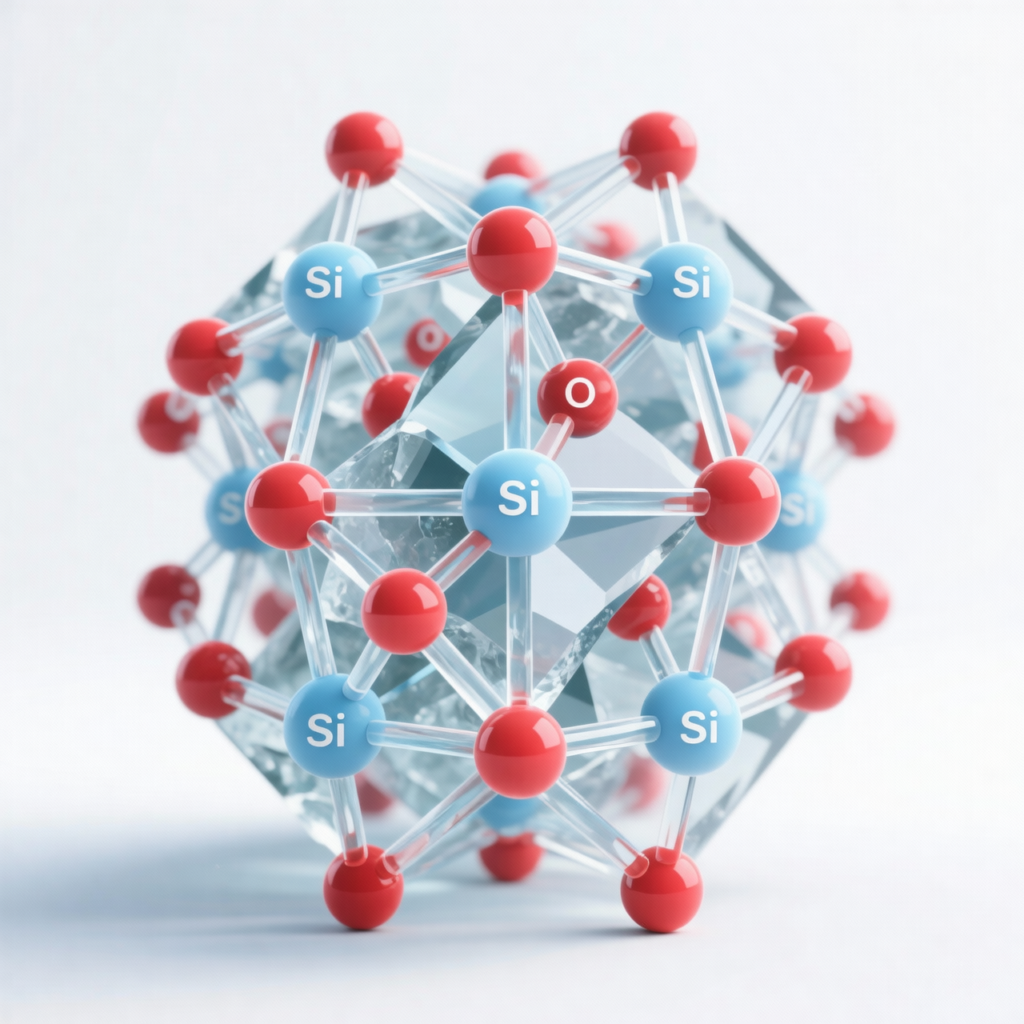
The essence of the ceramic-like claim is what happens during curing. Nanize describes the end state precisely. The company states that its coatings form hard, durable, glass-like and dense 3-dimensional Si-O-Si dominant cross-linked structures that are covalently bonded to the substrate.
That description is doing real work. “Glass-like” and “dense” speak to a tightly packed, hard surface. “Si-O-Si dominant” refers to the silicon-oxygen network that is the backbone of glass and ceramics. And “three-dimensional cross-linked” means the structure is a connected network in every direction, not a thin film. Together they describe a surface that behaves much more like a hard ceramic layer than like a soft polymer coating.
Hard, scratch-resistant, and long-lasting
The practical payoff of a ceramic-like structure is hardness and durability. Nanize connects the structure directly to these outcomes. It states that its coatings fully cure in under 1 minute below 70°C to create market leading hard scratch-resistant long-life coatings.
Hardness and scratch resistance are exactly the qualities you expect from a ceramic-like surface, and they are what make such a coating useful on things that get handled, wiped, or knocked. The company presents durability as a defining trait rather than a hope, tying it to the way the coating sets and bonds.
Why the bond keeps the ceramic in place
A hard layer is only valuable if it stays attached. This is where Nanize’s ceramic-like structure and its bonding chemistry reinforce each other. The durability and long-life of Nanize coatings is achieved through excellent cross-linking during the curing process, combined with covalent bonding to the substrate to prevent flaking and delamination in use.
A ceramic-like layer that is covalently bonded to the surface beneath it is fundamentally different from a hard layer merely resting on top. If it does not flake or delaminate, the ceramic-like protection persists rather than gradually chipping away.

Ceramic-like heat tolerance
One of the clearest signals that a coating is genuinely ceramic-like is how it behaves at high temperature. Ordinary polymer coatings break down with heat. Ceramics endure it. Nanize states that its chemistry can be tuned toward extreme heat tolerance, noting that bonding nano-additives to the backbone can, upon curing, confer characteristics such as super-hydrophobicity, operation at temperatures up to and above 1000°C, anti-microbial, corrosion resistance.
Operation at and above 1000°C is squarely in ceramic territory. It is a capability that a conventional organic coating simply cannot match, and it underlines that “ceramic-like” here is describing real behaviour, not just a marketing texture.
The best of both worlds
What makes the ceramic-like approach interesting is that it is applied like a coating but performs like a ceramic. It goes on as a liquid, using standard processes, and then cures quickly at low temperature into a hard, glass-like network. Nanize states that its coatings can be applied using standard high-volume industrial processes and cured quickly at temperatures below which damage might occur. That combination, the ease of a liquid coating with the endurance of a ceramic, is the heart of the ceramic-like proposition.
Where a ceramic-like surface earns its keep
The value of a ceramic-like coating shows up wherever surfaces face wear, heat, or contamination. Nanize points to protecting touchscreens, optical components, and solar modules from smudging and abrasion, among other uses. A hard, glass-like surface resists the scratches and wear that degrade these components, and the same density that makes it hard also makes it a barrier against dirt and moisture.
Why the structure is the story
The takeaway is that “ceramic-like” is not a loose adjective in Nanize’s case, it is a description of a specific structure: a dense, three-dimensional, silicon-oxygen network, covalently bonded to the surface beneath. That structure is what produces hardness, scratch resistance, longevity, and heat tolerance. Understanding the structure is the most honest way to understand why the coating behaves the way the company says it does.