
Walk through a single ordinary day and you brush past hundreds of surfaces. The painted metal panel on an office tower. The screen of your phone. A bus shelter tagged with spray paint. A frying pan in your own kitchen. Each of those surfaces fights a slow, losing battle against dirt, water, scratches, and wear. A Norwegian company called Nanize thinks one family of coatings can change the odds in all three settings at once: the factory, the house, and the public square.
The reason it can stretch that far comes down to flexibility. Nanize coatings can be applied to a wide variety of substrates including plastics, metals, and glass, and then functionalised to optimise performance for the job at hand. Nanize coatings covalently bond nano-particles to the polymer backbone, and unlike traditional solutions they are PFAS-free and customisable to confer specific desired performance such as anti-adhesion, non-wetting, and an extremely low coefficient of friction with no harmful chemicals.
In other words, it is not one product. It is a recipe that gets tuned. Let’s look at what that tuning does in each of the three worlds.

World One: The Factory Floor
Industry is where Nanize starts, because industry is where the coating has to survive the harshest treatment and still pay for itself.
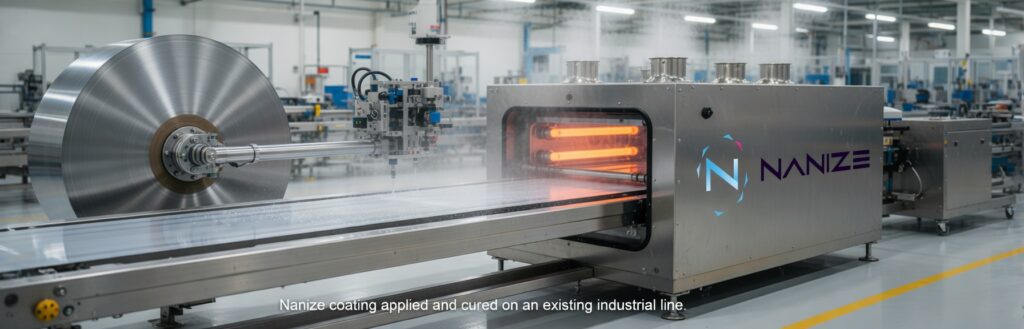
The first thing that matters to a manufacturer is whether a new material fits the machines they already own. Nanize built its process specifically so it does. The ultra-rapid curing process can be readily incorporated into existing industrial processes for coating steel, aluminium, glass and plastic, whether roll to roll, sheet to sheet or piece by piece. No factory wants to rip out a production line for a coating, and this one is designed to slot in.
The second thing is speed, because on a production line, time is the whole game. With catalyst-free, ultra-rapid, fully hard curing times of less than 30 seconds and below 100°C validated by FTIR, the Nanize curing process is both effective and economic. That curing claim has been backed up under the microscope. Complete curing in 30 seconds at 70°C is evidenced by FTIR spectrometry of Nanize polysilazane coatings applied by ultrasonic spray to stainless steel and aluminium, with the absence of Si-H and N-H on the cured samples and a corresponding strong Si-O-Si signal.
Then there is what the coating actually does once it is on the part. The real magic of this material family is that it can be programmed. A key feature of polysilazanes, which differentiates them from other similar polymers, is the ability to covalently bond nano-additives to the polymer backbone, which upon curing can confer specific coating performance characteristics such as super-hydrophobicity, operation at temperatures up to and above 1000°C, anti-microbial properties, and corrosion resistance.
That range opens up a long list of factory uses. Heat-resistant finishes for equipment running in punishing conditions. Corrosion barriers on machinery exposed to chemicals. Low-friction surfaces on parts that rub against each other and wear out. And because the coating protects sensitive components too, it reaches into electronics manufacturing. Nanize coatings, which can be applied using standard high-volume industrial processes and cured quickly at temperatures below which damage might occur, protect sensitive devices from their environment, and their dielectric properties make them especially suitable for use in batteries and other electronic assemblies.
The bottom line for industry is simple. Fewer worn parts, less downtime, lower energy bills from a cooler cure, and a finish that does not flake off after a month. That is the pitch that gets a factory manager to pick up the phone.
World Two: The Home
Now shrink the scale from a factory to a kitchen, and the same chemistry shows up in objects you touch every day.
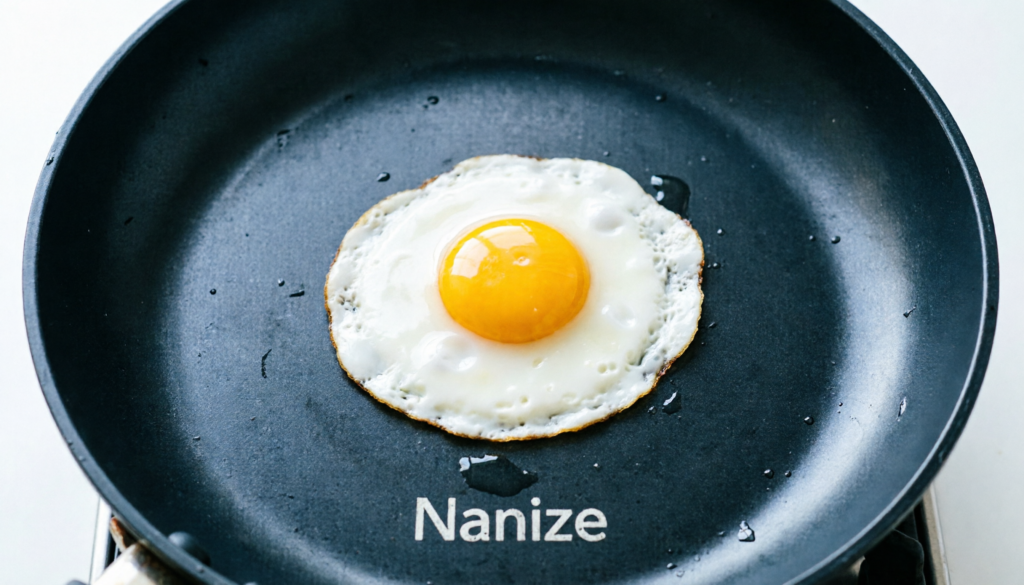
The most obvious is cookware. For decades, non-stick meant one thing: a fluorine-based coating that eventually scratches, peels, and ends up in the food and the landfill. Those coatings are now squarely in the sights of regulators. Nanize positions its technology as the clean replacement. As industries worldwide adapt to PFAS bans, Nanize is pioneering the next generation of non-stick coatings, with polysilazane technology that the company says not only meets but exceeds the performance standards of traditional PFAS-based solutions, making it a candidate for automotive, aerospace, industrial, and consumer applications.
But the home is bigger than the kitchen. Think about every glass, plastic, and metal surface in a house that you constantly wipe down. Shower glass that fogs and scales. Appliance fronts that show every fingerprint. Window panes that streak. Because the coating can be made strongly water-repelling and easy to clean, those are exactly the problems it is built to attack. The underlying material is also genuinely hard, not a soft film. Cured polysilazane coatings deliver high surface hardness and excellent scratch resistance, which is why they are already eyed for consumer electronics, automotive trim, and architectural glass. Polysilazane coatings deliver exceptional scratch resistance and surface hardness, addressing critical performance requirements in consumer electronics, automotive trim, architectural glass, and industrial equipment.
There is also a health angle that lands close to home. The same chemistry that confers super-hydrophobicity can also be tuned for anti-microbial performance, which in a home setting means surfaces that resist the build-up of bacteria on the things a family handles most. Combine “easy to clean,” “scratch resistant,” and “no forever chemicals,” and you have a coating that quietly makes a house lower-maintenance and a little safer.
World Three: Public Spaces
Step outside, and the toughest test of all begins. Public surfaces face weather, pollution, and vandalism, and nobody is there to baby them. This is arguably where Nanize’s case is strongest, because the savings are so easy to count.
Start with the skin of buildings. The exterior skins of buildings, such as claddings and curtain walls, are exposed to seasonal weather extremes and need to both retain their performance in protecting the building envelope and avoid visibly deteriorating in appearance through corrosion, soiling, or graffiti. Nanize’s answer is to treat the panel material before it ever goes up. By applying a Nanize polysilazane formulation to the typically used steel or aluminium building-skin material, followed by ultra-rapid curing in a high-throughput manufacturing process, the result is a durable, corrosion-resistant surface that is hydrophobic, non-marking, anti-graffiti, and not prone to soiling.
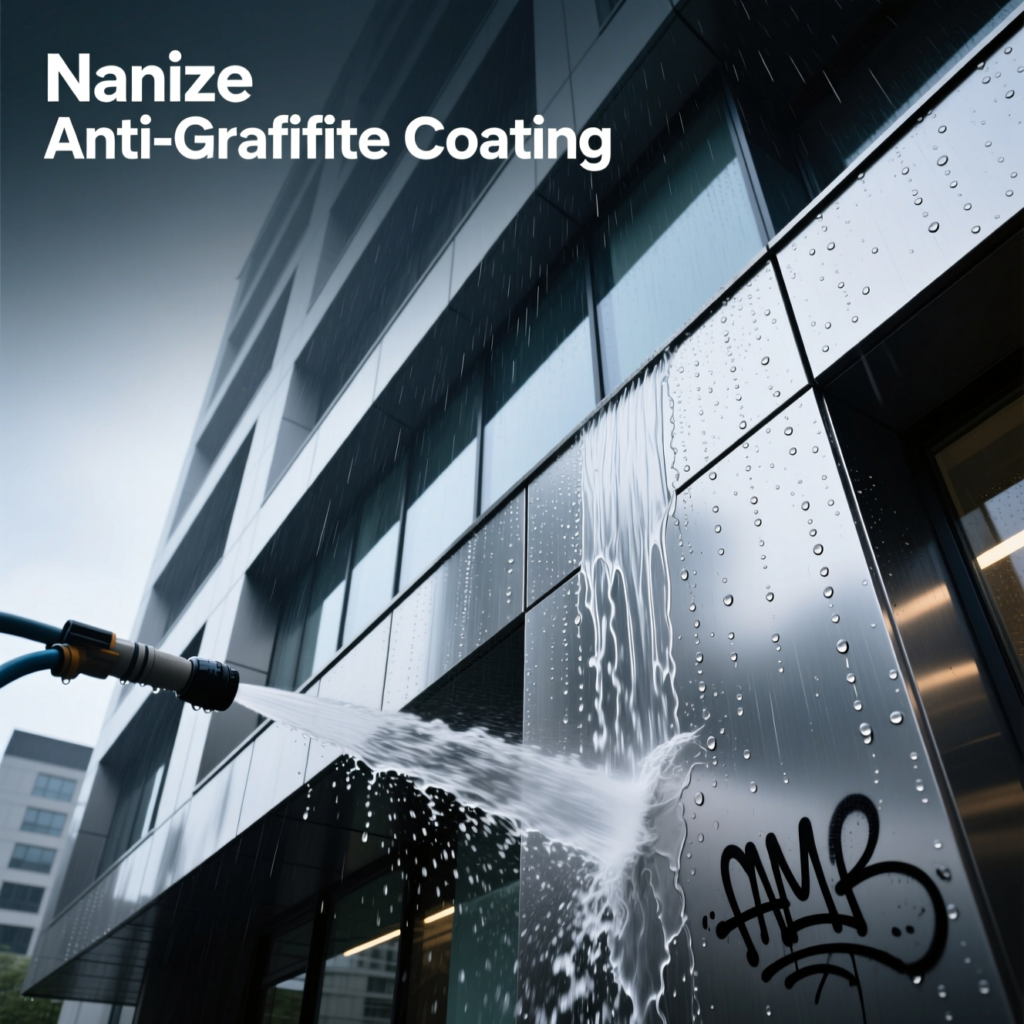
The payoff for cities and building owners is both financial and visual. The benefit of a long-life building skin that keeps its architectural appearance and functional performance while not requiring frequent cleaning from dirt build-up or graffiti removal is both economic and aesthetic. And crucially, protecting a building this way does not slow down how those panels are made. Because the Nanize coating uses standard industrial processes such as spraying, with ultra-rapid curing in less than one minute below 70°C, the high-volume, high-speed production of building materials is not compromised.
The same logic extends to the smaller, scruffier surfaces of a city. Bus shelters, signage, transit panels, and street furniture all suffer the same enemies. Anti-graffiti and anti-soiling versions of the coating are aimed precisely there. Anti-graffiti and anti-soiling coatings reduce maintenance on façades, glass, and public infrastructure. The coating is not limited to metal and glass either. With curing taking place below 70°C, durable formulations can be applied to a wide variety of substrates including plastics such as TPU film, producing coatings that can be high-volume manufactured cost-effectively with excellent non-marking, anti-graffiti, and stay-clean properties that are easy to maintain and durable.
For a city maintenance budget, that translates into fewer crews sent out to scrub tags, fewer panels replaced from corrosion, and infrastructure that looks cared-for for longer.
Why the Same Coating Works Everywhere
It is fair to ask how one technology can credibly serve a turbine factory, a kitchen, and a bus stop. The honest answer is that it is not really one coating, it is one platform with many settings. The base polymer is tough on its own: independent technical reviews of polysilazane coatings report pencil hardness of 8H or higher, along with strong heat, fire, wear, and oxidation resistance. The resulting silica coatings exhibit hardness values of 8H or higher on the pencil hardness scale, combined with excellent heat resistance, fire resistance, wear resistance, and oxidation resistance. They also bond hard to the surface underneath, which is what stops them peeling. Cross-hatch adhesion testing yields top 5B ratings with no delamination on metals, glass, and ceramics after thermal cycling, and pull-off adhesion strength on aluminium and steel exceeds that of typical epoxy primers.

On top of that hard, well-bonded base, Nanize bonds different nano-additives to dial in whatever the job needs. Slipperiness for a machine part. Water-shedding for a window. Graffiti resistance for a wall. The chemistry stays the same; the additives change. That is what lets a single company tell a turbine engineer, a cookware brand, and a city planner that it has something for each of them.
The Honest Caveats
A few things are worth keeping in view. Nanize is a small, young company still scaling up, and many of the strongest comparisons, such as likening its durability to space-grade coatings, come from the company and its own coverage rather than independent field testing. Nanize itself frames the comparison by noting that NASA has invested in advanced non-stick technologies for spacecraft, and says it is forging a path that rivals those achievements while delivering commercially viable, rapidly curing coatings at industrial scale. That is a bold framing, and real-world performance across thousands of buildings, pans, and bus shelters will be the true test.
There is also a sustainability thread running through all three worlds that strengthens the case. Beyond regulatory alignment, the technology reduces manufacturing waste and supports greener production practices, a key factor driving interest from sustainability-focused corporations. A coating that is PFAS-free, cures cool and fast, and lasts longer is easier to justify whether it is going on a factory part, a frying pan, or a city wall.
The Takeaway
Most material breakthroughs solve one narrow problem. What makes Nanize interesting is the breadth. The factory gets a tough, fast-curing, programmable finish that fits its existing lines. The home gets non-stick, easy-clean, scratch-resistant surfaces without the forever chemicals. The public square gets buildings and infrastructure that shrug off weather, dirt, and graffiti. It is the same idea wearing three different coats, and if it delivers on even part of the promise, you will end up brushing past it many times a day without ever knowing it is there.