
A Small Team With a Big Problem to Solve
In the Arctic city of Narvik, a small team is quietly working on a material problem that touches almost everything you own. Nanize is a pioneering Norwegian company at the forefront of nano-technology coatings. Based in Narvik, the team is dedicated to developing innovative, sustainable, and highly durable coatings that address industry challenges, including cost-effectiveness and scalability.
The company is young and lean. Nanize was founded in 2019, is headquartered in Narvik, Norway, and has 8 total employees. Yet despite its size, it has attracted attention from investors and industry veterans alike. Nanize has raised $633K, with Arctic Investment Group, Deep Future, and Valinor AS having invested in the company.
The “Forever Chemical” Problem
To understand why Nanize matters, you have to understand the material it aims to replace: PFAS, the family of “forever chemicals” best known through Teflon.
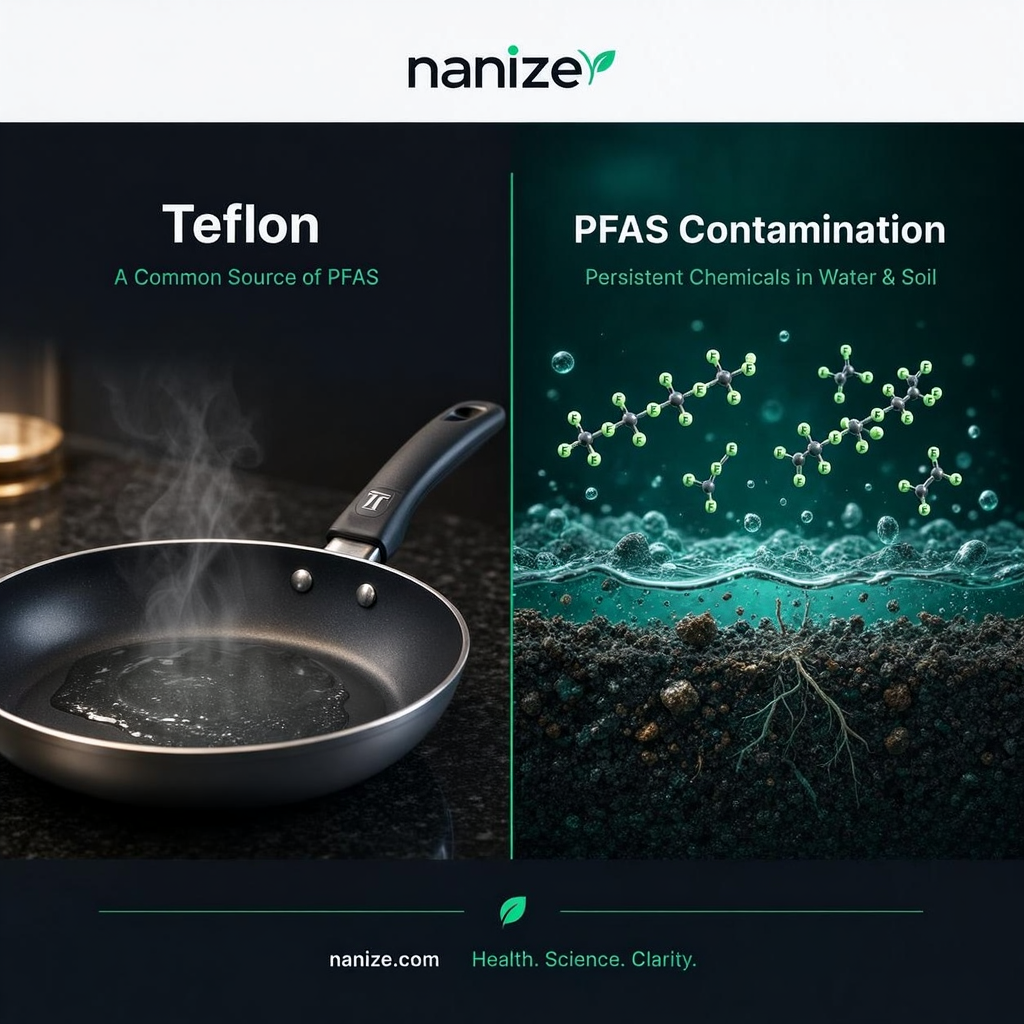
PFAS coatings are extraordinarily useful — and extraordinarily widespread. Teflon-type material gets used everywhere: gaskets, valve stem seals and O-rings in cars; wires, cables, fuel hoses in spacecraft; capacitors and printed circuit boards in computers; and stents, joint implants and heart patches in people. The trouble is that once we built our world around it, the downsides emerged. Sometimes called “forever chemicals,” this kind of material takes forever to degrade, so it has been contaminating water, soil and air, ending up in bodies.
The health concerns are significant. Research has linked these chemicals to increased cancer risk, decreased fertility, developmental delays in children, weakened immune response and interference in hormone functions. The regulatory response has been swift and global. PFAS chemicals are being banned, and not just in Europe.
That regulatory pressure is exactly the gap Nanize is built to fill. Nanize is a materials innovation company focused on developing PFAS-free coatings that replace traditional fluorinated chemicals — designing hydrophobic, oleophobic, and protective surface technologies without persistent pollutants, supporting manufacturers under increasing global regulatory pressure to eliminate PFAS.
The Science: Cracking the Polysilazane Code
The heart of Nanize’s technology is polysilazane — a polymer with remarkable potential that has long been held back by one stubborn limitation: curing.
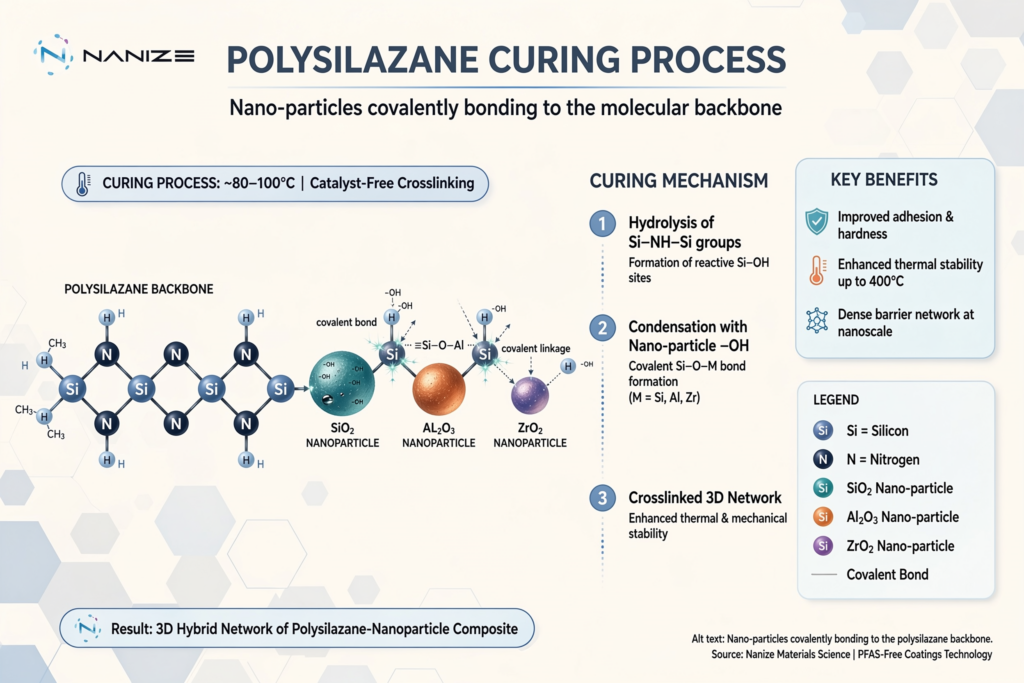
Historically, getting polysilazane to set fully and hard has been slow and energy-intensive. Nanize’s breakthrough was solving that. As one observer put it bluntly: Nanize figured out how to cure polysilazane — not in days, or hours, or minutes, but in seconds.
The numbers behind the chemistry are striking. With catalyst-free ultra-rapid fully hard curing times of less than 30 seconds and below 100°C validated by FTIR, the Nanize curing process is both effective and economic. What makes the coating so durable is how it bonds. Nanize coatings covalently bond nano-particles to the polymer backbone, which enhances the already impressive characteristics of commercial polysilazane. Unlike traditional solutions, Nanize coatings are PFAS-free and customisable to confer specific desired performance such as anti-adhesion, non-wetting, and extremely low coefficient of friction — with no harmful chemicals.
The bonding is what separates a coating that flakes from one that lasts. The patented technology achieves near-perfect cross-linking and covalent bonding to the substrate through hydrolysis of polysilazanes in under 1 minute and below 70°C. And that durability is the entire point. The long-life of Nanize coatings is achieved through excellent cross-linking during the curing process, combined with covalent bonding to the substrate to prevent flaking and delamination in use.
How Slick Is “Slick”? A New World Record
Here’s where the story gets genuinely jaw-dropping. Friction is measured by a “coefficient of friction” — the lower the number, the slipperier the surface.
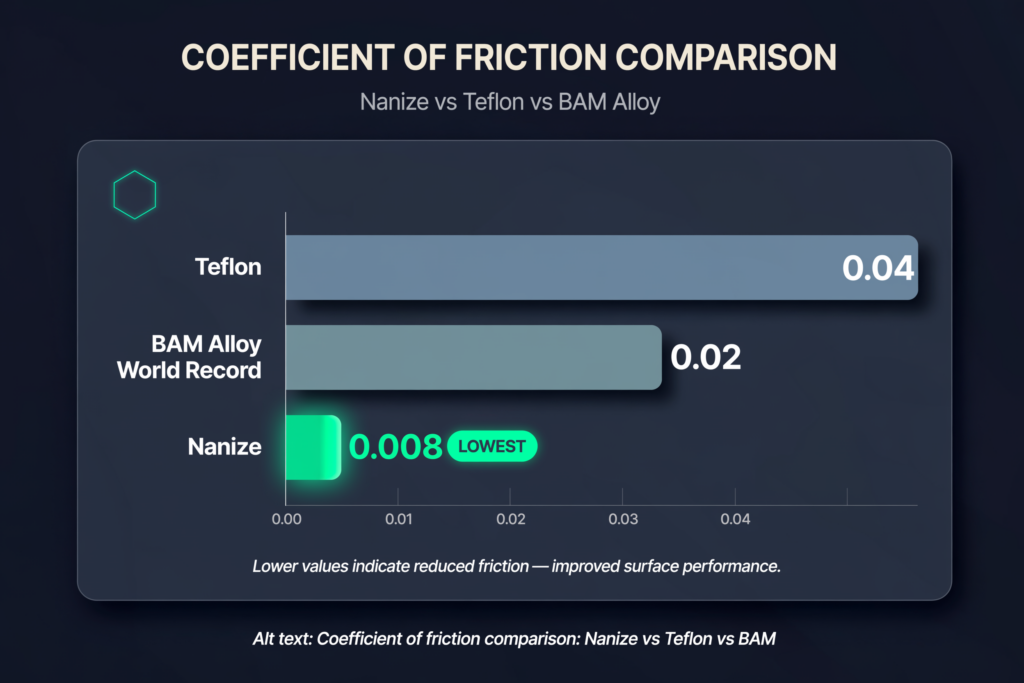
For context: Teflon’s coefficient of friction is 0.04. The previous world record of 0.02 belonged to an alloy of boron-aluminum-magnesium, but using it in practice has been limited because it doesn’t want to stick to anything. Nanize shattered that benchmark. Nanize has a coefficient of friction of 0.008 — literally the slickest stuff on Earth.
It’s a claim that opens the door to wild possibilities. Imagine super-slick boat hulls, airplane wings, and Formula 1 cars; razor blades that don’t need shaving cream; hypersonic snowboards; the ultimate frying pan. Nanize aims to go everywhere Teflon went — and beyond.
Built for the Factory Floor, Not Just the Lab
Plenty of lab-grade nanotech never makes it to mass production. Nanize’s founders are acutely aware of this. As the company notes, most nano coatings’ weak points are durability, cost effectiveness, and difficulties scaling up — many people have seen great proven nano technology that only lasts a very short time.
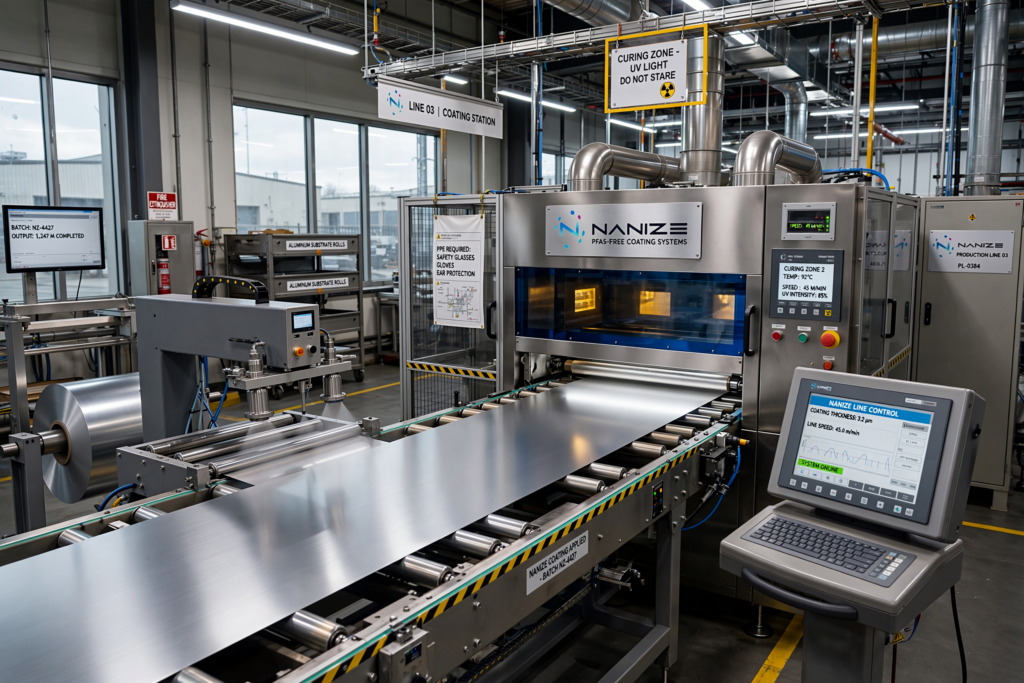
The company’s answer is to build on equipment the industry already uses. The Nanize ultra-rapid curing process can be readily incorporated into existing industrial processes for coating steel, aluminium, glass and plastic — whether roll to roll, sheet to sheet or piece by piece. That scalability is what excites the people who know the market best. One expert called it the key to unlocking a long-stalled industry: “Nanize is the missing piece for scaling polysilazane surface coatings. The market potential is extremely significant and set to grow rapidly,” said Jürgen Mertes, former Head of Polysilazane Sales at Merck Performance Materials GmbH.
Where You’ll See It: Real-World Applications
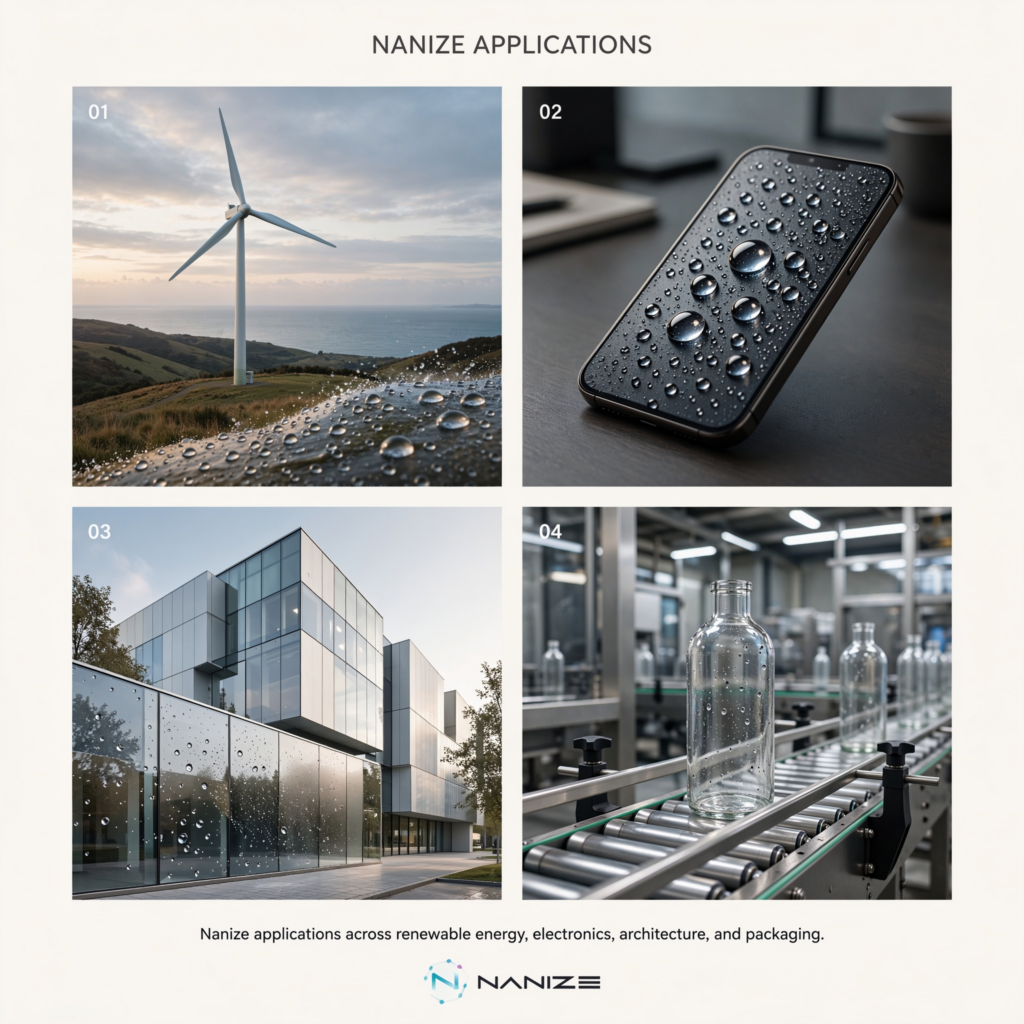
Nanize isn’t a single product — it’s a platform of customizable formulations. The versatility of the coatings is accelerating adoption across industries: aerospace and automotive engineers are applying it to wind turbine blades, exterior body panels, and other low-drag components; electronics makers use it to protect touchscreens, optical components, and solar modules; and medical device makers and cookware brands benefit from long-lasting, bacteria-resistant finishes.
Some concrete examples from Nanize’s own case studies:
Architecture & Building Skins.
By applying a Nanize coating to steel or aluminium building-skin material and ultra-rapidly curing it, manufacturers create a durable, corrosion-resistant surface that is hydrophobic, non-marking/anti-graffiti and not prone to soiling — producing long-life building skins that retain their architectural appearance while needing far less cleaning.
High-Speed Packaging.
For high-volume production of small, delicate bottles moving along conveyors with multiple touch points, Nanize’s ultra-rapidly cured polysilazane coatings can be applied to both the bottles and the production equipment for improved efficiency, less waste, and reduced cost.
Automotive Sensors & Exteriors.
Exterior automotive plastics — from headlamp covers to protective housings for LIDAR and camera sensors — suffer from abrasion, scratching, and impaired function from water and dirt build-up, a problem Nanize’s hard, scratch-resistant hydrophobic coatings are designed to solve.
Renewable Energy.
Through Nanize formulations and the ultra-rapid curing process, the energy-generation performance of solar modules and wind turbines can be improved, with a corresponding reduction in the downtime needed for cleaning.
The performance ceiling is remarkably high. The same polysilazane chemistry that enables slickness can also confer super-hydrophobicity, operation at temperatures up to and above 1000°C, anti-microbial properties, and corrosion resistance, depending on the nano-additives bonded to the polymer backbone.
The NASA Comparison
Nanize doesn’t shy away from bold positioning. The company likens its durability to space-grade standards. While NASA has famously invested in advanced non-stick technologies for spacecraft and satellites that withstand extreme environments, Nanize is forging a path that rivals those achievements, delivering commercially viable, environmentally responsible, and rapidly curing non-stick coatings at industrial scale. The distinction it draws is commercial readiness: its polysilazane coatings exhibit ceramic-like endurance akin to the extreme performance NASA requires in space, but — unlike NASA’s often mission-specific solutions — Nanize’s coatings are ready for widespread adoption in high-volume markets, from auto manufacturing to building construction.
The Sustainability Angle
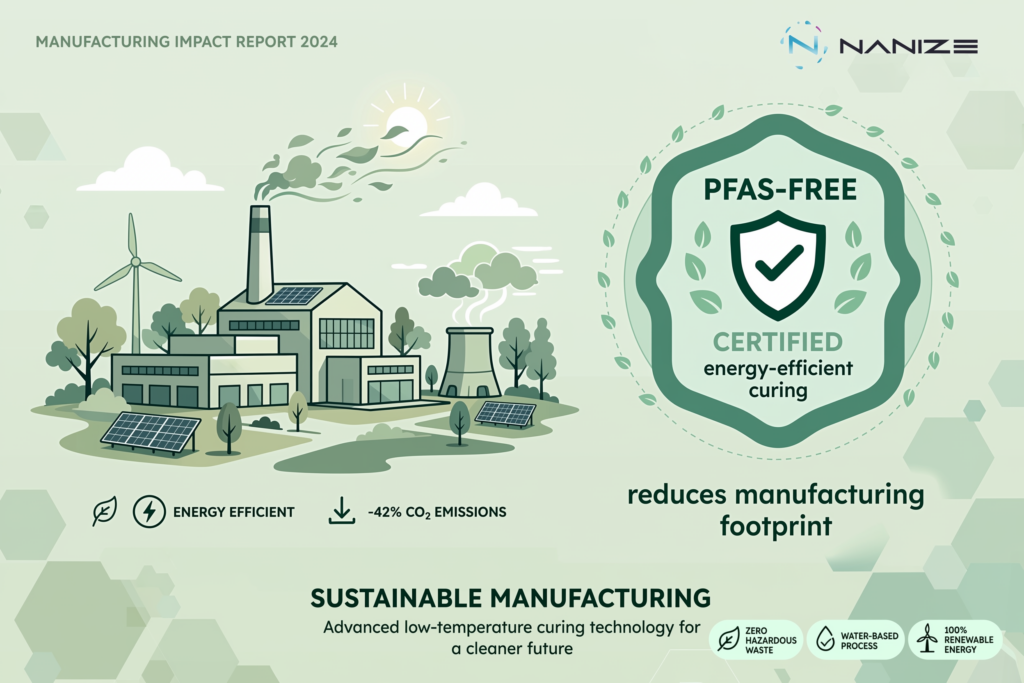
Beyond performance, the environmental case may be Nanize’s strongest commercial tailwind. The fast, low-temperature cure is itself a sustainability win. The material fully sets in about a minute at temperatures below 100°C — dramatically faster and more energy-efficient than traditional high-heat curing methods — which, for manufacturers under pressure to reduce emissions and streamline operations, represents a significant competitive advantage. And the green benefits don’t come at the cost of performance: despite eliminating PFAS entirely, Nanize’s formulations deliver exceptional hydrophobic and oleophobic properties, resisting water, oils, and a wide range of contaminants.
The company frames this as enabling a broader industrial shift. Nanize provides nano solutions that enhance properties while reducing material consumption and maintenance costs, providing stepping stones for tomorrow’s sustainable solutions.
The Mission Ahead
Nanize’s ambition is to make its technology a default rather than a niche. The company’s stated mission is to revolutionize surface technology through sustainable innovation, pushing the boundaries of nanotechnology to deliver products that exceed industry standards — with a vision of a future where its nano-technology coatings become the standard in surface protection across industries.
For now, the team in Narvik is making the case to the world’s manufacturers one industry at a time. As an emerging industry voice summarized it: Nanize is emerging as a frontrunner in this new era, advancing PFAS-free coatings that outperform many legacy non-stick technologies — and, powered by its polysilazane chemistry, is becoming a preferred partner for automotive, aerospace, electronics, medical, and consumer-goods manufacturers seeking next-generation surface protection.