
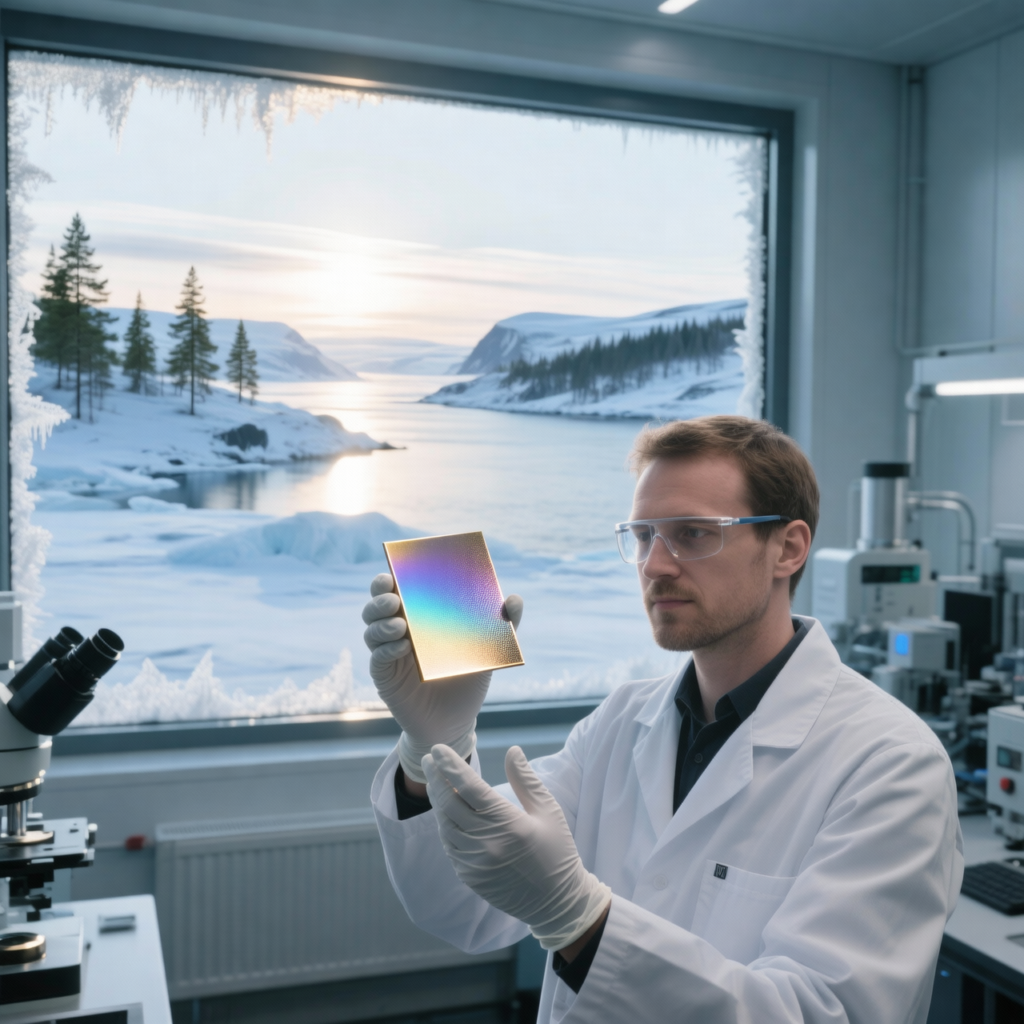
Some of the most useful materials in science spend years sitting just out of reach. They work beautifully in theory, perform well in a lab, and then stall when someone tries to actually manufacture with them. Polysilazane was one of those materials. For a long time it carried a reputation as a near-ideal coating that nobody could quite use at scale. The story of how that changed runs through a small company in the Arctic Norwegian town of Narvik.
A material with enormous promise
To understand the breakthrough, you first have to understand why polysilazane was so attractive in the first place. It is a polymer that, once properly cured, forms a hard, glass-like ceramic layer. Nanize describes the cured result as hard, durable, glass-like and dense 3-dimensional Si-O-Si dominant cross-linked structures that are covalently bonded to the substrate. That combination, a tough ceramic surface chemically locked to whatever sits beneath it, is exactly what engineers want from a protective coating.
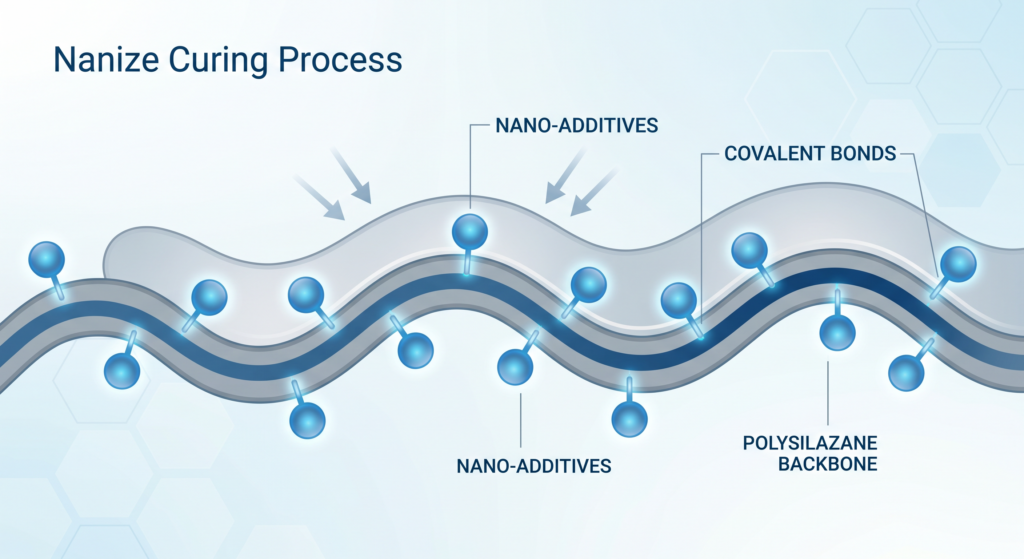
The other appeal is versatility. Unlike many coatings that do one job, polysilazane can be adjusted. According to Nanize, the ability to covalently bond nano-additives to the polymer backbone can, upon curing, confer specific characteristics such as super-hydrophobicity, operation at temperatures up to and above 1000°C, anti-microbial, corrosion resistance. In other words, the same base chemistry could be tuned toward water repellency, extreme heat tolerance, hygiene, or rust protection depending on what was added to it.
The problem that held it back
So why wasn’t polysilazane already everywhere? The answer comes down to curing, the process of getting the liquid coating to set hard. Nanize is direct about this being the central obstacle. The company states that it recognised that the excellent potential of polysilazane coatings has been constrained by the ability to achieve a high cross-linking density on curing.
Curing is not a minor technical footnote. If a coating takes too long to set, or needs extreme heat to do it, it simply cannot fit into real manufacturing. Slow curing ties up production lines. High-temperature curing rules out anything heat-sensitive, like plastics or electronics. A material that needs either one is destined to stay a niche curiosity, no matter how good the finished surface might be.
Cracking the curing problem
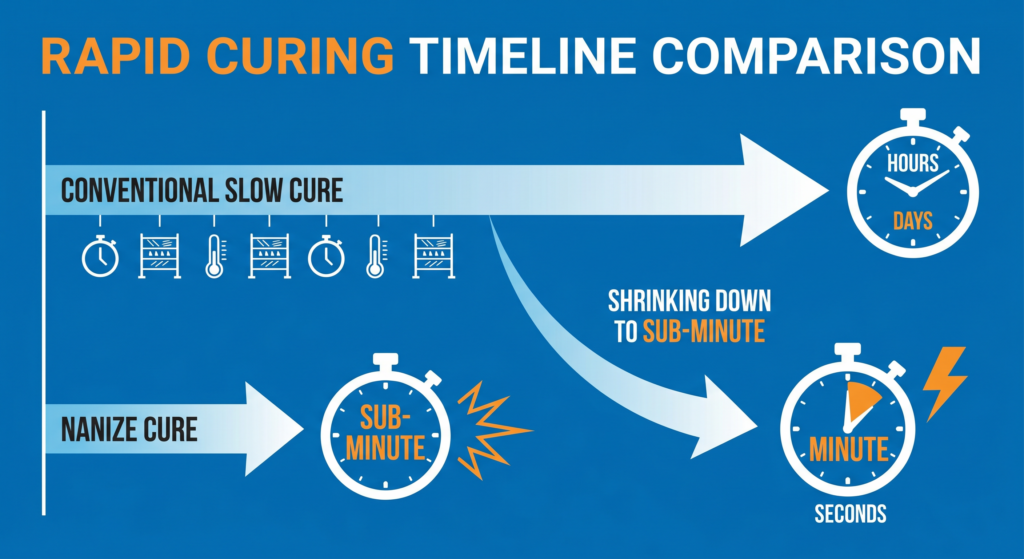
Nanize’s central contribution is a curing process that removes those constraints. The company states that the patented technology developed by Nanize achieves near-perfect cross-linking and covalent bonding to the substrate through hydrolysis of polysilazanes in under 1 minute and below 70°C.
Read that again, because the two numbers are what matter. Under a minute, and below 70°C. The company restates the speed on its own site: Nanize coatings fully cure in under 1 minute below 70°C to create market leading hard scratch-resistant long-life coatings. It also describes the process as involving catalyst-free ultra-rapid fully hard curing times of less than 30 seconds. Achieving a hard cure without a catalyst, at low temperature, in seconds, is the combination that had been missing.
Backing the claim with testing
A bold curing claim invites scrutiny, and Nanize points to laboratory evidence. The company states that complete curing in 30 seconds at 70°C is evidenced by FTIR spectrometry of Nanize polysilazane coatings applied by ultrasonic spray to stainless steel and aluminium, noting the absence of Si-H and N-H on the cured samples, with a corresponding strong Si-O-Si.
That last part is the chemical fingerprint of a finished cure. The Si-H and N-H signals belong to the uncured material; once those disappear and a strong Si-O-Si signal appears, the glass-like network has formed. Nanize also frames this as part of a wider testing effort, stating that, having made over 20,000 individual tests, extensive lab validation of Nanize coatings has been undertaken, including by FTIR, to verify polymer crosslinking, hard curing, durability and performance.
Why the bond is the real story
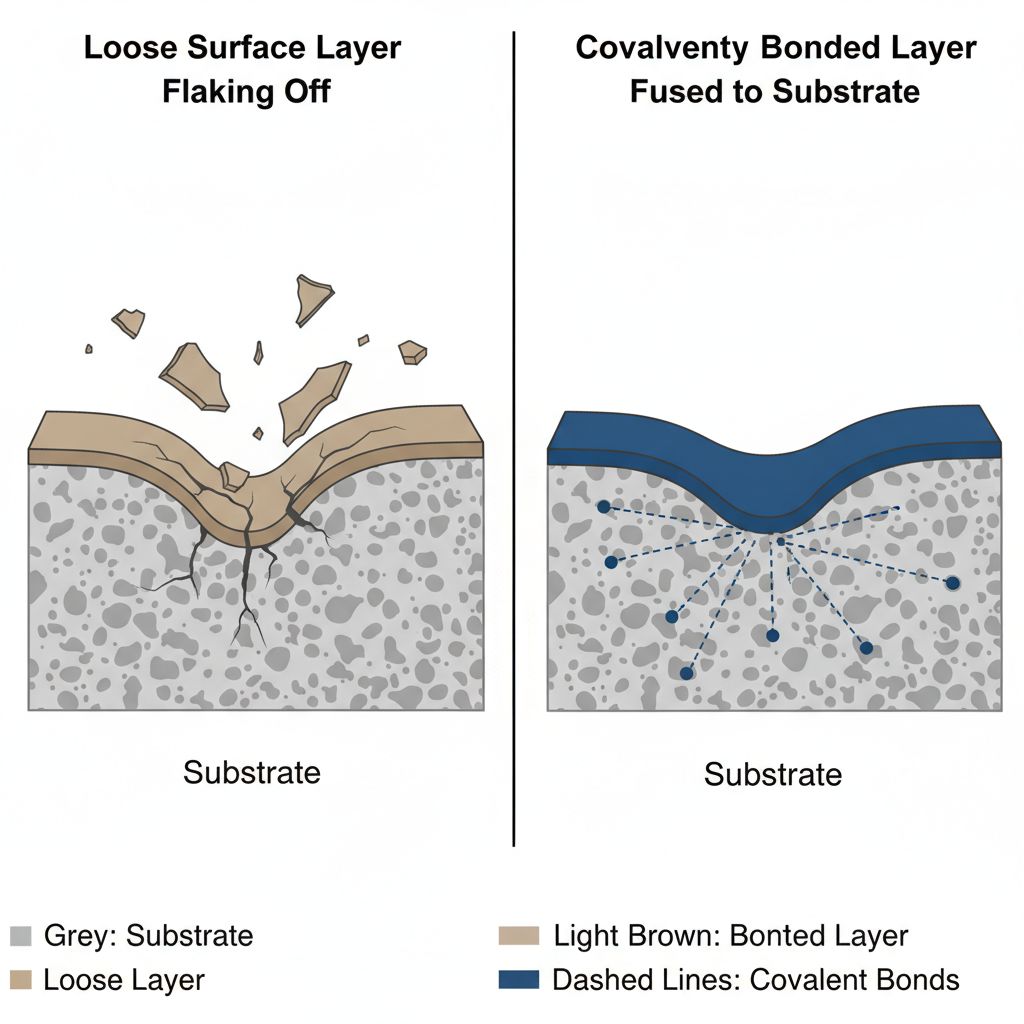
Speed grabs attention, but the durability claim rests on adhesion. A coating that sets fast is only useful if it then stays put. Nanize ties its longevity directly to how the coating attaches. The durability and long-life of Nanize coatings is achieved through excellent cross-linking during the curing process, combined with covalent bonding to the substrate to prevent flaking and delamination in use.
This is the difference between a layer sitting on top of a surface, waiting to chip away, and a layer that has chemically become part of that surface. The company also emphasises that the coating bonds at the molecular level rather than simply being mixed in. Nanize coatings covalently bond nano-particles to the polymer backbone which enhances the already impressive characteristics of commercial polysilazane.
A material built to be used, not just admired
What makes the Nanize story interesting is not that the company invented polysilazane. It did not. The material already existed and was already admired. The contribution is making it practical, turning a coating that needed days or high heat into one that sets in seconds at low temperature and fits standard manufacturing.
The company frames its whole mission around bringing this kind of technology into the real world. Nanize is a materials innovation company focused on developing PFAS-free coatings that replace traditional fluorinated chemicals across packaging, textiles, consumer products, and industrial sectors. It positions its work as serving manufacturers under increasing global regulatory pressure to eliminate PFAS, which connects the curing breakthrough to a much larger shift away from fluorine-based chemistry.
Why it matters
Strip the story down and it is a lesson in how innovation often works. The dramatic part is rarely inventing a brand new substance. More often it is removing the one stubborn obstacle that kept a good idea from being useful. For polysilazane, that obstacle was curing. By making the cure fast, cool, and catalyst-free, Nanize is attempting to move a long-promising material from the lab bench onto the factory floor.
The real verdict will come from years of large-scale industrial use, and from independent validation of the boldest claims. But the direction is clear, and it is a genuinely interesting one: take a material the industry already wanted, and finally make it practical enough to use.