
Patented and Unique: What Genuinely Sets Nanize’s Technology Apart
The word “unique” gets thrown around loosely in materials marketing. Almost every coating claims to be different in some way. So it is worth taking the claim seriously and asking a harder question about Nanize: what, specifically and verifiably, sets its technology apart? Working only from what the company states, a clear picture emerges, and it rests on a few concrete pillars rather than vague superlatives.
Pillar one: a patented curing process
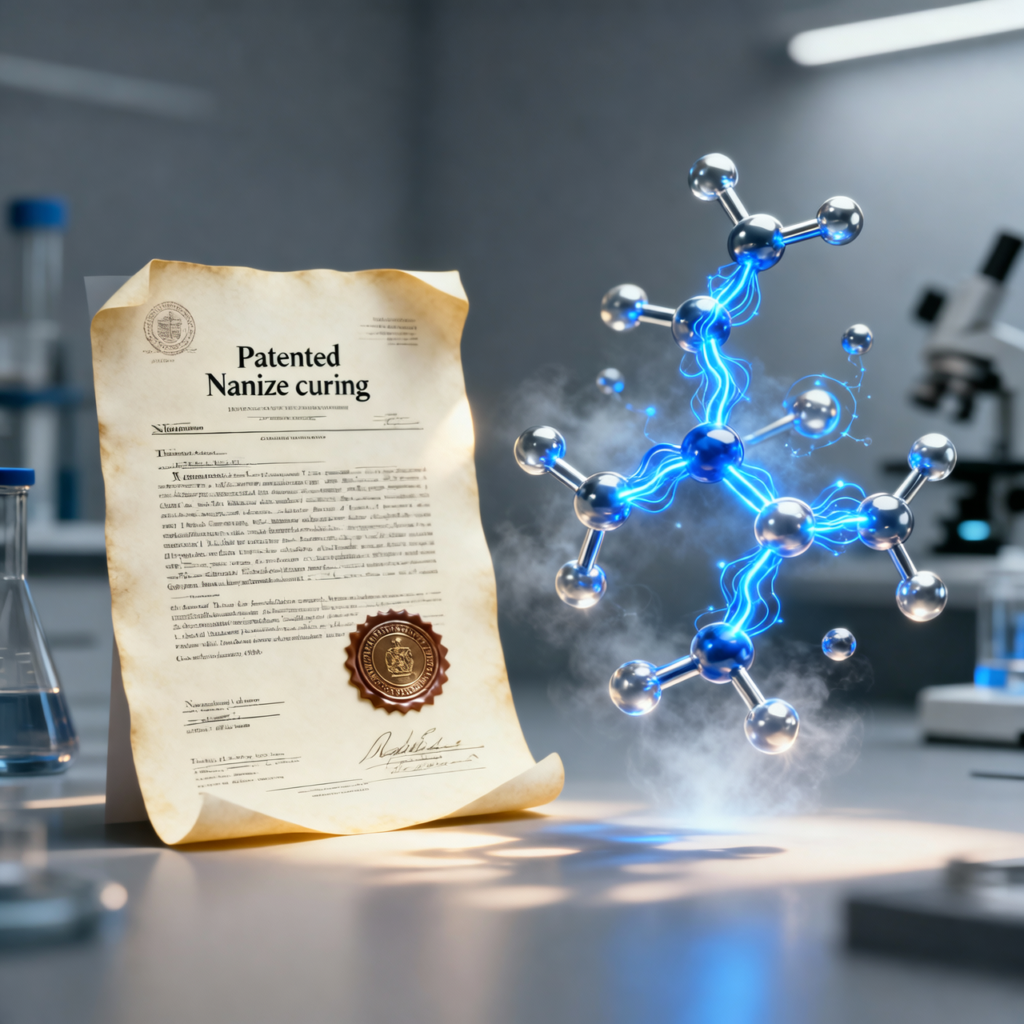
The most defensible claim to uniqueness is a patent, because a patent is a formal, examined assertion of novelty. Nanize points directly to this. The company states that the patented technology developed by Nanize achieves near-perfect cross-linking and covalent bonding to the substrate through hydrolysis of polysilazanes in under 1 minute and below 70°C.
That single sentence carries a lot of weight. It ties the word “patented” to a specific, measurable achievement: near-perfect cross-linking and covalent bonding, accomplished quickly and at low temperature. The uniqueness is not an abstract boast. It is anchored to a process that the company has moved to protect legally.
Pillar two: solving a problem others hadn’t
Uniqueness is easier to believe when it answers a problem the wider field had struggled with. Nanize frames its work exactly this way. It states that it recognised that the excellent potential of polysilazane coatings has been constrained by the ability to achieve a high cross-linking density on curing.
In other words, the raw material was known and admired, but a specific barrier held it back. Nanize’s distinct contribution is addressing that barrier directly. The company describes catalyst-free ultra-rapid fully hard curing times of less than 30 seconds, and states that its coatings fully cure in under 1 minute below 70°C to create market leading hard scratch-resistant long-life coatings. Achieving a hard cure without a catalyst, at low temperature, in seconds, is the combination that distinguishes the approach.
Pillar three: bonding at the molecular level
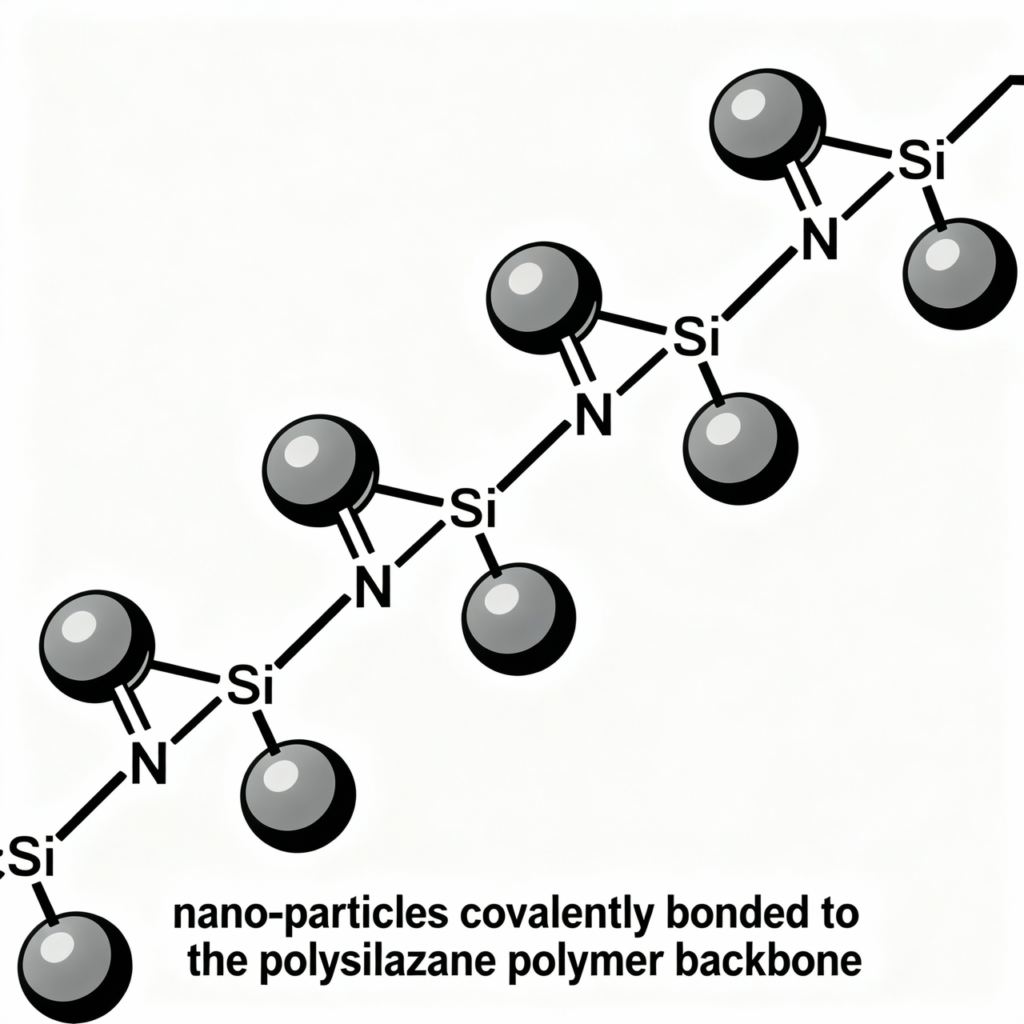
A third element of Nanize’s uniqueness is how nano-additives are integrated into the coating. Many coatings simply mix particles into a matrix. Nanize describes something more specific. Nanize coatings covalently bond nano-particles to the polymer backbone which enhances the already impressive characteristics of commercial polysilazane.
The company presents this bonding capability as a defining feature of the chemistry. According to Nanize, the ability to covalently bond nano-additives to the polymer backbone can, upon curing, confer specific characteristics such as super-hydrophobicity, operation at temperatures up to and above 1000°C, anti-microbial, corrosion resistance. Because the additives are chemically joined to the backbone rather than loosely dispersed, the resulting properties are built into the structure of the coating itself.
Pillar four: customisation from a single platform
Another distinctive quality is that Nanize is not a single fixed product but an adjustable platform. Unlike traditional solutions, Nanize coatings are PFAS-free and are customisable to confer specific desired performance such as anti-adhesion, non-wetting, extremely low coefficient of friction and other properties with no harmful chemicals.
This matters because it means one underlying technology can be steered toward very different jobs. The company describes tailoring formulations to the setting, noting that from lightweight electronics to heavy-duty industrial machinery, Nanize tailors each formulation to match specific performance needs. A platform that adapts is harder to replicate than a one-note product.
Backed by testing, not just assertion
Claims of uniqueness are stronger when supported by data. Nanize points to a substantial testing programme. The company states that, having made over 20,000 individual tests, extensive lab validation of Nanize coatings has been undertaken, including by FTIR, to verify polymer crosslinking, hard curing, durability and performance. It also offers specific evidence for the cure itself: complete curing in 30 seconds at 70°C is evidenced by FTIR spectrometry of Nanize polysilazane coatings applied by ultrasonic spray to stainless steel and aluminium, noting the absence of Si-H and N-H on the cured samples, with a corresponding strong Si-O-Si.
Why the uniqueness holds together
Put the pillars side by side and the claim becomes coherent. A patented curing process. A specific, long-standing problem addressed. Molecular-level bonding of additives. A customisable single platform. And a large body of testing behind it. None of these alone would justify the word “unique,” but together they describe a technology that is genuinely distinct in approach, not just in branding