

The Case for a Global-Leading, PFAS-Free, High-Performance Coating
Bold positioning invites scrutiny, and it should. When a company describes its technology as leading, high-performance, and PFAS-free, the responsible thing is to test each part of that claim against what can actually be verified. Done honestly, the exercise is revealing. Nanize’s positioning holds up not because of adjectives, but because each element connects to something specific the company states about the technology.
High performance, defined by properties
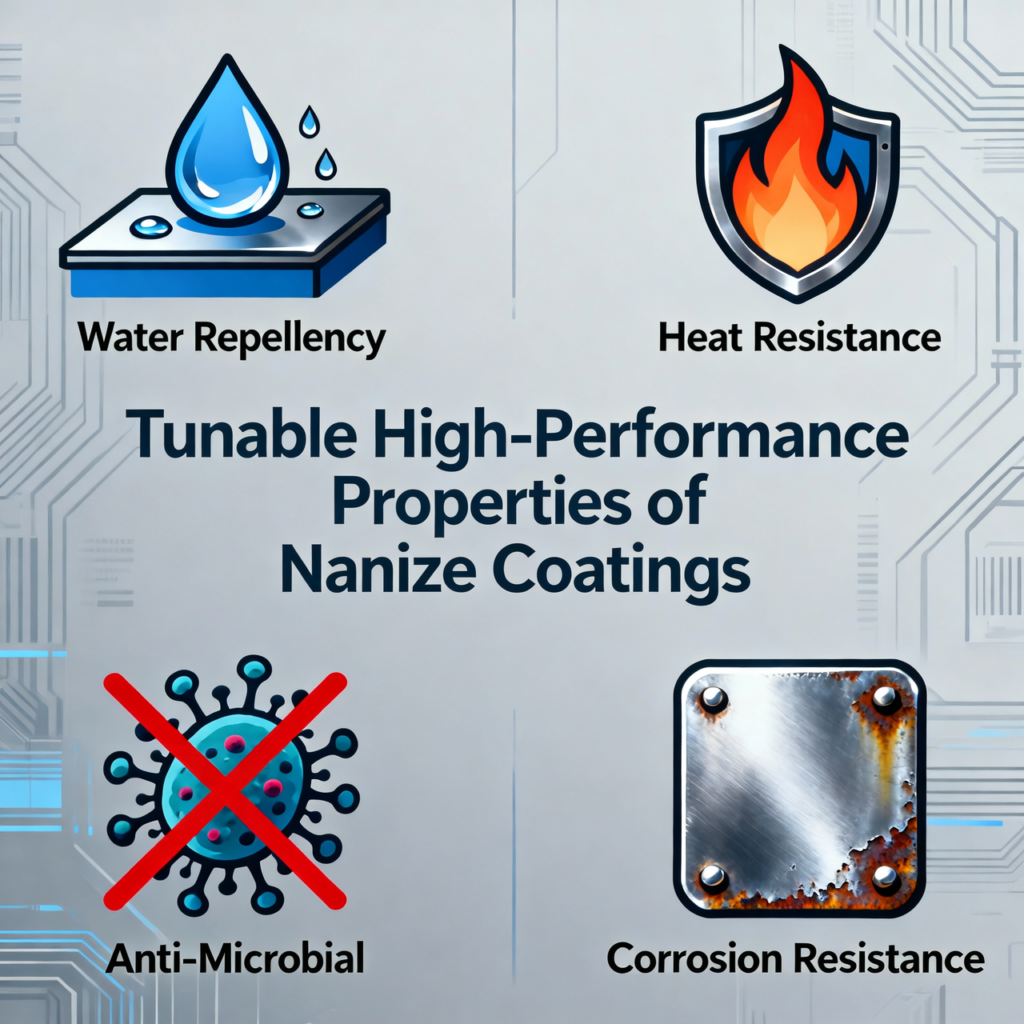
“High-performance” only means something if it points to real capabilities. Nanize’s coatings are described in terms of a set of demanding properties that can be tuned into the material. According to Nanize, the ability to covalently bond nano-additives to the polymer backbone can, upon curing, confer specific characteristics such as super-hydrophobicity, operation at temperatures up to and above 1000°C, anti-microbial, corrosion resistance.
That is a genuinely high-performance list: extreme water repellency, ceramic-level heat tolerance, hygiene, and rust protection, all from one platform. The company also emphasises hardness and longevity, stating that its coatings fully cure in under 1 minute below 70°C to create market leading hard scratch-resistant long-life coatings.
PFAS-free, by design
The second pillar is the absence of PFAS, and here the claim is central to the company’s identity rather than incidental. Nanize is a materials innovation company focused on developing PFAS-free coatings that replace traditional fluorinated chemicals across packaging, textiles, consumer products, and industrial sectors. It states plainly that its coatings are PFAS-free and are customisable to confer specific desired performance such as anti-adhesion, non-wetting, extremely low coefficient of friction and other properties with no harmful chemicals.
What makes this credible as a “leading” position is timing. Regulatory pressure on PFAS is rising globally, and Nanize frames its work as supporting manufacturers under increasing global regulatory pressure to eliminate PFAS. A high-performance coating that is also PFAS-free is aligned with exactly the direction the industry is being pushed.
Performance without the usual trade-off
The most persuasive part of the “high-performance and PFAS-free” claim is that Nanize presents the two as compatible rather than opposed. Historically, matching the performance of fluorinated coatings without fluorine has been the hard part. Nanize’s position is that its coatings deliver demanding performance while eliminating PFAS entirely, offering anti-adhesion and non-wetting properties with no harmful chemicals. Achieving the performance without the problematic chemistry is the crux of the leadership claim.
Leading, in the sense of solving what others hadn’t
The word “leading” is best justified not by market share, which is not publicly detailed, but by technical leadership on a specific problem. Nanize frames itself as having addressed a barrier that constrained an entire class of coatings. It states that it recognised that the excellent potential of polysilazane coatings has been constrained by the ability to achieve a high cross-linking density on curing, and that its patented technology achieves near-perfect cross-linking and covalent bonding to the substrate through hydrolysis of polysilazanes in under 1 minute and below 70°C.
Leading a field often means being first to make a difficult thing practical. That is the sense in which the claim is most defensible: a patented process that turns a long-constrained material into one that cures in seconds at low temperature.
Credibility through validation
A leadership claim is stronger when backed by evidence, and Nanize points to a substantial testing record. The company states that, having made over 20,000 individual tests, extensive lab validation of Nanize coatings has been undertaken, including by FTIR, to verify polymer crosslinking, hard curing, durability and performance. It offers a concrete example in the cure itself: complete curing in 30 seconds at 70°C is evidenced by FTIR spectrometry of Nanize polysilazane coatings applied by ultrasonic spray to stainless steel and aluminium.
Built to reach real industries
Finally, “high-performance” is only meaningful if the technology can actually be used at scale. Nanize stresses that its coatings can be applied using standard high-volume industrial processes and cured quickly at temperatures below which damage might occur. Performance that fits existing manufacturing, rather than requiring exotic conditions, is what turns laboratory capability into industrial value.
Why the positioning is defensible
Assemble the verified pieces and the claim coheres. The performance is real and specific: hardness, heat tolerance, water and dirt repellency, corrosion and anti-microbial capability. The PFAS-free status is central and timely. The leadership rests on a patented solution to a genuine, long-standing problem. And the whole thing is backed by a large testing programme and designed for standard manufacturing. That is a credible foundation for calling the technology a leading, high-performance, PFAS-free coating, provided the boldest specifics are left for independent, large-scale validation over time.