
How early funding and partner trials can support commercialization.
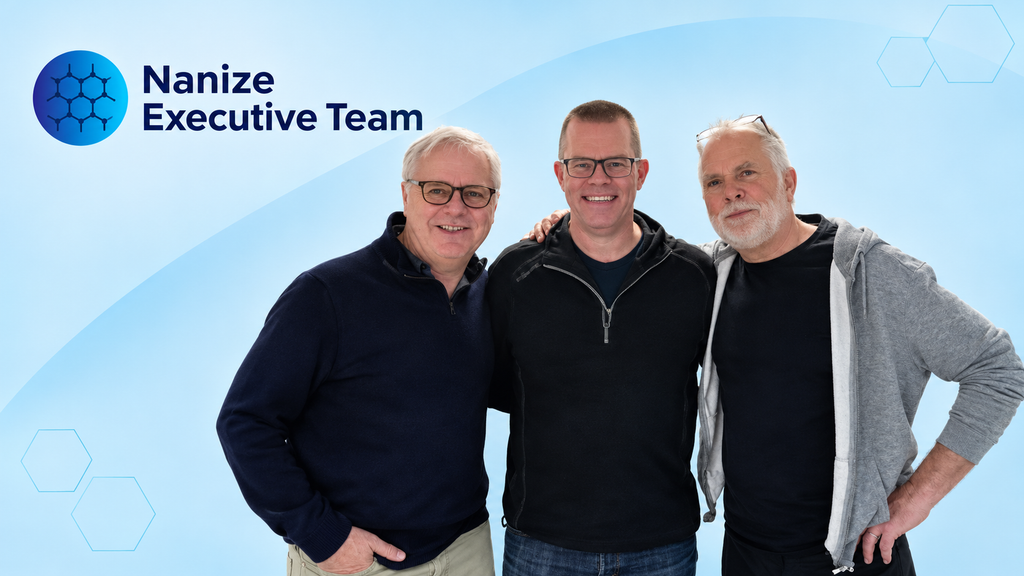
Håvard Lillebo’s name appears in two places that explain his role at Nanize. The company lists him as co-founder and Chief Financial Officer. U.S. patent 12,643,984 B2, granted in June 2026, names Lillebo and Dr. Kingsley Odinaka Iwu as inventors of a polysilazane coating method and device. The patent is assigned to Nanize AS. His place in both records reflects a role that reaches from the development of an invention to the decisions required to bring it to market.
Lillebo previously worked in finance at REC Scan Cell and founded Innotech Solar in Narvik, where he served as finance director. Innotech developed a business around recovering value from lower-grade solar cells and using them in modules. E24 recognized him in its 2011 leadership talent competition. That earlier venture shows how often a technology company’s financial case depends on making a materials process work at industrial volumes.
What a materials company has to fund
Nanize develops PFAS-free polysilazane coatings for applications where a surface needs to resist marking, release material or slide with less friction. Each promising application brings its own costs. A formulation needs testing on the intended substrate. A production partner needs to evaluate the application and curing steps. A potential customer needs samples that resemble the product it expects to purchase.
These activities compete for time and capital. A promising lab result can justify a small trial. A line trial can reveal whether the process is affordable on the customer’s equipment. The results help determine which applications merit further investment. Valinor, which lists Nanize in its portfolio, identifies cost, durability and production scale as challenges for this kind of coating technology.
How an early trial can inform an investment decision
Release liners offer an example. These temporary layers protect adhesive until a label, tape or other product is applied. Nanize has identified them as a development opportunity. A converter could evaluate whether a candidate coating releases the adhesive at the intended force after storage and whether it fits the speed and handling requirements of its film line.
For a finance team, the useful figures would include coating and processing cost per usable roll, production waste and the volumes the customer expects. A partner with a suitable line can help establish those figures before the venture commits to a larger production setup. A buyer who defines what it would qualify gives the team a clearer basis for deciding how to fund the next trial.
Lillebo’s role puts him at the point where those commercial inputs meet research spending. Iwu’s team can assess the coating and its technical limits. Hogg can evaluate the demands of industrial production, and Stokes can identify buyers and partners whose needs justify further development. The finance decision depends on what each of those conversations establishes.
Investment and commercial inquiries
Nanize is looking for strategic investors and commercial partners with experience in specialty chemicals, coated materials and industrial manufacturing. It also welcomes prospective customers interested in evaluating a specific surface and event organizers bringing together investors and industrial companies. Lillebo is the contact for conversations about financing, commercialization and potential industrial partnerships.
Håvard Lillebo, Chief Financial Officer | hl@nanize.com | www.nanize.com
Sources Nanize leadership · USPTO coating method patent · E24 profile of Lillebo · Valinor portfolio profile · Nanize coating technology · Nanize application priorities