
Rapid curing and the path to high volume manufacturing.
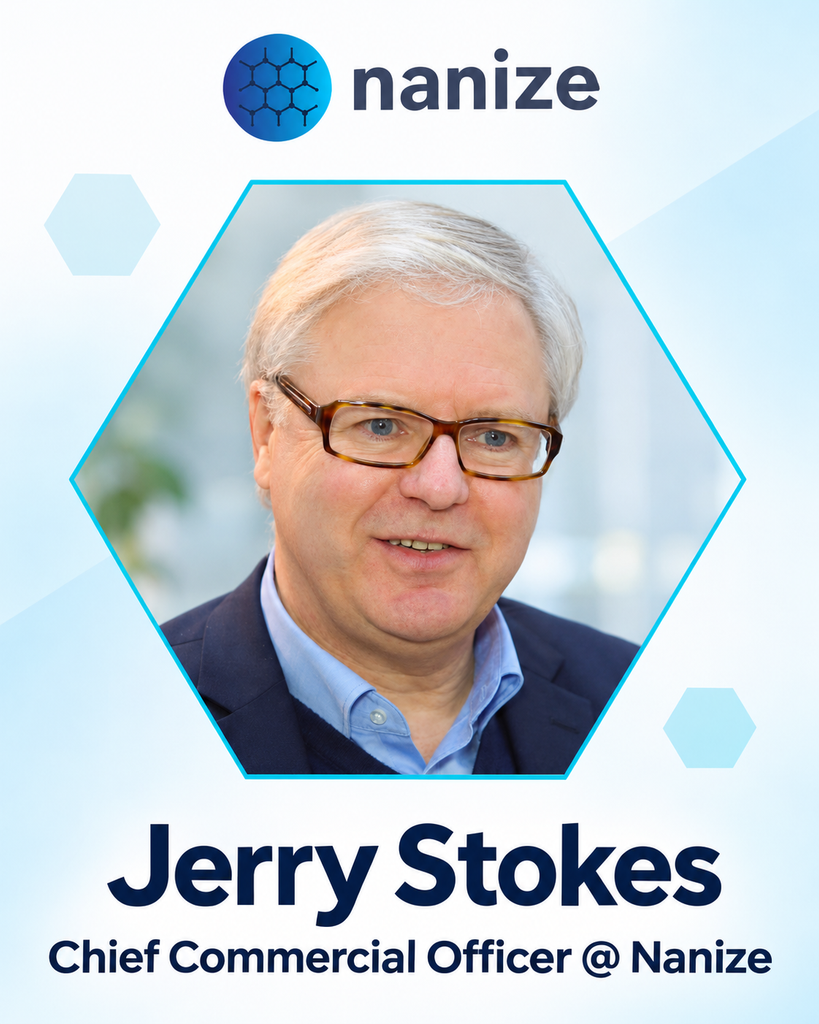
A November 5, 2026 executive profile traced Jerry Stokes’s career from batteries and solar manufacturing to his role as Chief Commercial Officer of Nanize. In a January feature for Innovation News Network, Stokes described Nanize coatings for metals, plastics and glass. He outlined why short curing times at lower temperatures could help manufacturers coat materials that are sensitive to prolonged heating.
At Nanize, Stokes’s work concerns how a coating moves into a customer’s product and production line. The question matters to component makers, coaters and distributors because each handles a different part of the process. It matters to investors because the cost of qualifying and supplying a repeatable finish can determine which applications are ready to pursue first.
What Nanize is taking to market
Nanize develops PFAS-free polysilazane formulations and methods to cure them. The coatings can be designed to make surfaces easier to clean, improve release or reduce unwanted sliding friction. The U.S. Patent and Trademark Office issued patent US 12,643,984 B2 on June 2, 2026, for a polysilazane coating method and device and lists Nanize AS as the assignee.
Nanize separately reports that selected coatings reached full cure on tested metal samples in less than a minute at temperatures below 100 °C. The company uses Fourier-transform infrared spectroscopy to assess chemical changes during cure. A coating line trial would also measure the time needed to prepare, apply, inspect and handle the finished component. Those steps together determine whether a process can fit the plant’s production rate.
Where partnerships could speed adoption
A contract coater could evaluate whether the formulation and cure process fit its equipment. A manufacturer could supply a part with a defined problem, such as residue that sticks to a production fixture or markings that are hard to remove from a polymer surface. A distributor could identify customers with similar parts and maintenance routines. Each partner can help establish where the formulation has enough value to merit qualification.
For strategic investors, the questions follow the same path. Which part has a measurable problem? Can a coating solve it through the expected wear and cleaning cycles? Can a manufacturing partner apply it at an acceptable cost per part? A pilot with a defined reference surface, service conditions and production volume can provide a basis for discussing scale-up.
A global invitation to events and investors
Nanize is actively seeking events worldwide, along with new commercial partners, investors and clients. Examples of upcoming gatherings for the coatings industry include the European Coatings Show in Nuremberg from April 27 to 29, 2027, and Coating Show Indonesia in Jakarta from May 19 to 21, 2027. Nanize welcomes approaches from organizers across Europe, Asia, the Americas, the Middle East and Africa, including materials conferences, manufacturing exhibitions and investor showcases.
An organizer can discuss a presentation on qualifying rapid-cure coatings, a comparison of treated samples or a joint session with a manufacturer. Prospective customers and partners can share a surface problem, application and production target. Investors interested in advanced materials can contact Stokes to discuss Nanize’s commercialization plans and the kinds of partnerships that can support them.
Jerry Stokes, Chief Commercial Officer | js@nanize.com | www.nanize.com
Sources November 2026 executive profile · Innovation News Network feature · Nanize leadership · Nanize coating technology · USPTO patent record · European Coatings Show · Coating Show Indonesia