
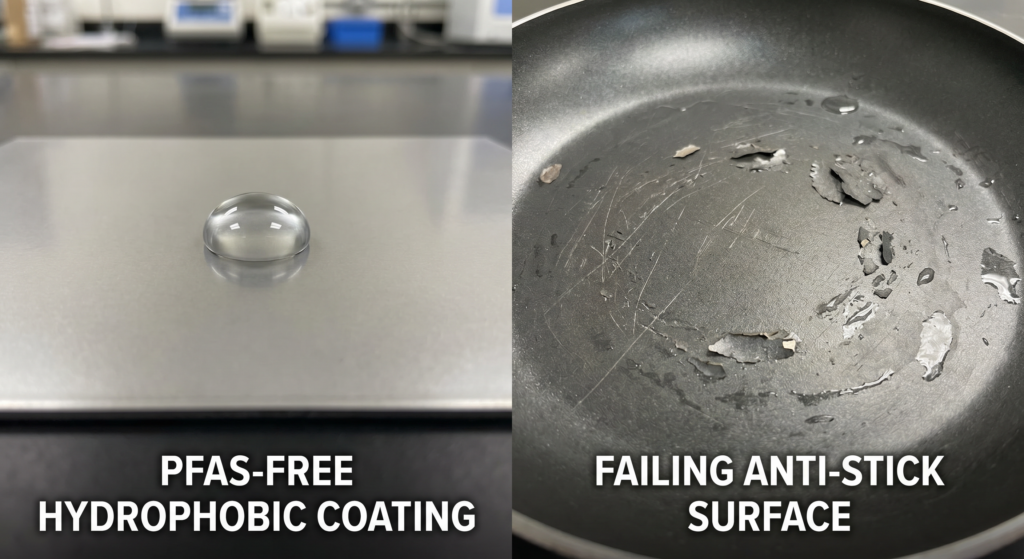
PFAS-Free Hydrophobic Coatings: Why Anti-Stick Coatings Fail and What to Use Instead
For decades, the easiest way to make a surface repel water and resist sticking was to use PFAS — fluorine-based “forever chemicals.” As regulations tighten and traditional anti-stick coatings fail in familiar ways, manufacturers need durable, PFAS-free alternatives. This article explains how to achieve hydrophobic performance without PFAS, why existing anti-stick coatings fail, and what to look for in a replacement.
Part 1: How to make surfaces hydrophobic without PFAS
The shift away from PFAS
PFAS chemicals face growing restrictions, pushing industries toward alternatives that match their water- and oil-repelling performance without persistent pollutants.
A PFAS-free route to hydrophobic surfaces
Nanize is built specifically around this objective. Nanize is a materials innovation company focused on developing PFAS-free coatings that replace traditional fluorinated chemicals across packaging, textiles, consumer products, and industrial sectors. The company designs hydrophobic, oleophobic, and protective surface technologies without persistent pollutants, supporting manufacturers under increasing global regulatory pressure to eliminate PFAS.
Removing PFAS doesn’t have to mean weaker repellency. Despite eliminating PFAS entirely, Nanize’s formulations deliver exceptional hydrophobic and oleophobic properties, resisting water, oils, and a wide range of contaminants. The result is a durable, easy-clean surface ideal for environments where appearance and hygiene matter.
The chemistry behind it
Nanize’s repellency comes from how the coating is built at the molecular level. Nanize coatings covalently bond nano-particles to the polymer backbone which enhances the already impressive characteristics of commercial polysilazane. According to Nanize, the ability to covalently bond nano-additives to the polymer backbone can, upon curing, confer specific characteristics such as super-hydrophobicity, operation at temperatures up to and above 1000°C, anti-microbial, corrosion resistance.
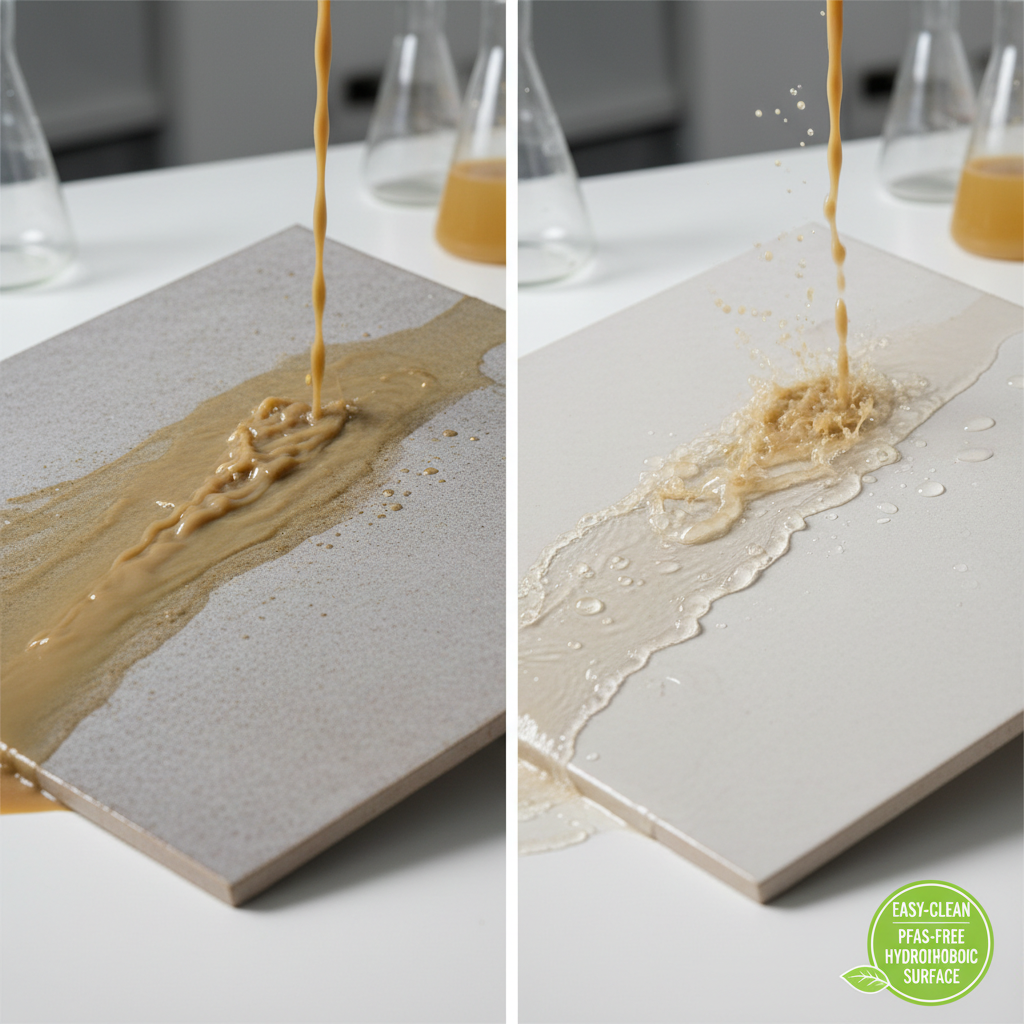
How hydrophobicity reduces dirt build-up
Water- and oil-shedding surfaces give grime less to cling to. Nanize coatings have a high degree of hydrophobicity and an extremely low coefficient of friction that significantly reduces the build-up and adhesion of dirt on the surfaces to which they are applied.
Part 2: Why your current anti-stick coating fails — and what to use instead
Anti-stick coatings typically fail in three ways: they flake, they wear, or they fall out of regulatory compliance.
Failure mode 1: Flaking and delamination
A coating that merely sits on top of a surface can peel away over time. Nanize’s stated answer is a chemical bond instead of a loose layer. The durability and long-life of Nanize coatings is achieved through excellent cross-linking during the curing process, combined with covalent bonding to the substrate to prevent flaking and delamination in use. Nanize describes the cured result as hard, durable, glass-like and dense 3-dimensional Si-O-Si dominant cross-linked structures that are covalently bonded to the substrate.
Failure mode 2: Regulatory non-compliance (PFAS)
Many traditional anti-stick coatings depend on PFAS, which face tightening restrictions. By eliminating PFAS, Nanize ensures that businesses remain compliant with new regulations while protecting ecosystems.
Failure mode 3: Scratching and wear
Anti-stick surfaces also degrade through abrasion. Nanize lists hardness and scratch resistance as core properties. Nanize coatings fully cure in under 1 minute below 70°C to create market leading hard scratch-resistant long-life coatings.
What to use instead
When replacing a failing coating, look for strong substrate bonding, PFAS-free chemistry, and scratch resistance. Nanize presents its platform as adjustable to different needs. Unlike traditional solutions, Nanize coatings are PFAS-free and are customisable to confer specific desired performance such as anti-adhesion, non-wetting, extremely low coefficient of friction and other properties with no harmful chemicals.