
A modern car is a machine at war with its own surfaces. Every exterior panel battles weather, road salt, grit, and UV. Every moving part inside the engine and drivetrain fights friction, heat, and the slow grind of metal against metal. For most of automotive history, the answer to both problems was the same: paint and oil, reapplied and replaced as they wore out. Nano coatings are quietly rewriting that approach, and a Norwegian company called Nanize sits right at the centre of the shift.
This article looks at two connected stories: how nano coatings protect the surfaces you can see, and how ceramic-grade coatings reduce the wear and friction inside the parts you cannot.
This article tries to answer that honestly. To understand why Nanize stands apart, you have to line it up against the two things it competes with: the old fluorine-based coatings like Teflon, and the newer wave of “ceramic” and nano coatings that were supposed to replace them. On both fronts, the case for Nanize comes down to a handful of concrete differences.
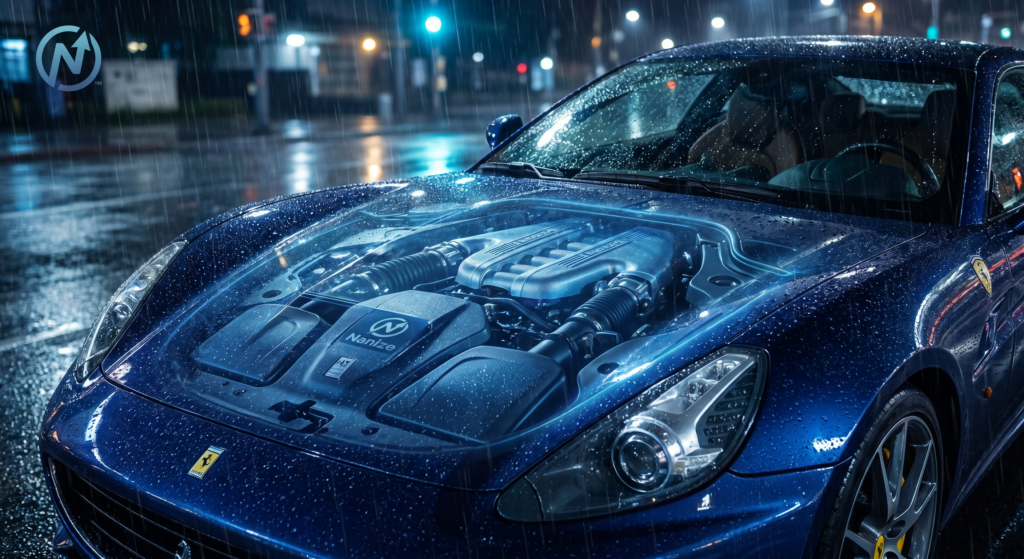
Part One: Protecting the Surfaces You Can See
The exterior problem
The outside of a vehicle is a punishing environment, and increasingly it is not just paint that suffers. Modern cars are studded with delicate plastic optics and sensor housings that have to stay clear to function. Nanize identifies this directly: exterior plastics used within the automotive sector, ranging from headlamp covers to protection for sensors such as LIDAR and cameras, suffer from abrasion and scratching, and from impaired function due to the build-up of water and dirt.
That last point is the modern twist. A scratched bumper is cosmetic. A fogged or dirt-caked sensor cover is a safety problem, because the camera or LIDAR behind it feeds the driver-assistance systems the car relies on. The coating that protects these surfaces is no longer just about looks.
Why nano coatings work where paint and wax don’t
The advantage of a nano coating is that it bonds to the surface rather than resting on top of it, and it can be made both hard and water-repelling at once. Nanize coatings fully cure in under one minute below 70°C to create market-leading, hard, scratch-resistant, long-life surfaces. The water-shedding behaviour is the key to keeping optics clear. Nanize coatings have a high degree of hydrophobicity and an extremely low coefficient of friction that significantly reduces the build-up and adhesion of dirt on the surfaces to which they are applied.
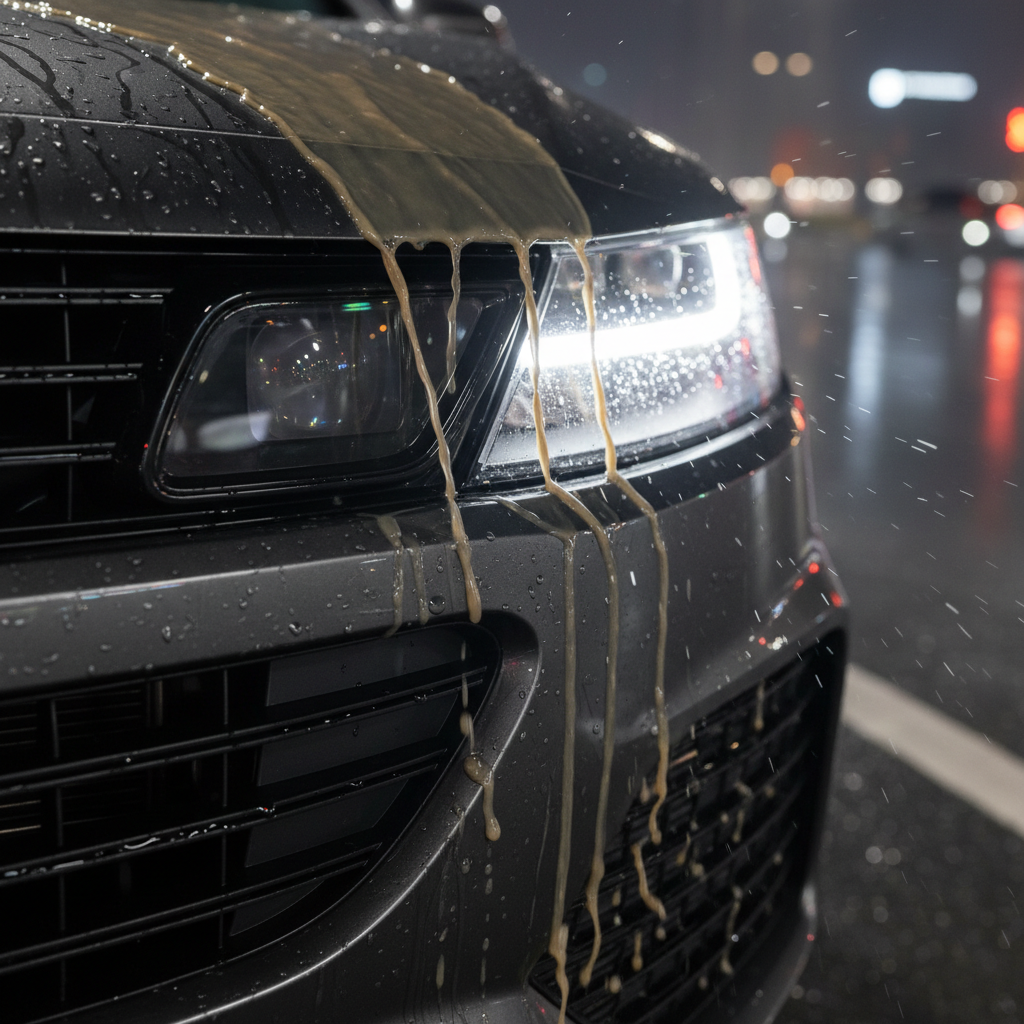
For the visible bodywork, the broader detailing industry has already proven what this chemistry does. The class of coating Nanize uses, polysilazane, forms a glass-like protective layer. Polysilazane creates a covalent bond directly with the substrate, resulting in a glass-like shield that is significantly more resistant to swirl marks and light abrasions than conventional silicon-dioxide coatings. That is the difference between a wax that washes off in a few weeks and a coating chemically married to the panel.
The contrast with what most of the market sells is stark. Most “ceramic” coatings are actually based on silicone or silicon dioxide, and a silicone-based nano ceramic coating merely lies on top of the substrate as a sacrificial layer without an excellent covalent bond, so beyond water repellency it does not offer good durability, heat, chemical, scratch, or stain resistance, and its efficiency decreases significantly over time. A true covalently bonded coating doesn’t degrade that way, because it isn’t a separate layer waiting to wear off.
What the driver actually gets
The everyday payoff is mundane and welcome: a car that stays cleaner, scratches less, and keeps its finish for years. Nanize frames its exterior coatings as protecting touchscreens, optical components, and exterior parts from smudging, dirt, and abrasion, and the appeal is broad enough that automotive engineers are already applying the technology to exterior body panels and other components that demand ultra-smooth, low-drag surfaces.
There is even an aerodynamic angle. An ultra-smooth, low-friction skin means less drag, and the same low-friction property that sheds dirt also helps air flow more cleanly over the body, a small efficiency gain that matters across the life of a vehicle.
Part Two: Cutting Wear and Friction Inside the Machine
The second story is invisible but arguably more valuable. Friction inside an engine and drivetrain is not a minor nuisance; it is one of the single biggest sources of wasted energy in a car.
The scale of the friction problem
The numbers are sobering. Across a vehicle’s mechanical systems, friction consumes a large share of the fuel a car burns, and reducing it directly improves both efficiency and component life. This is exactly the territory low-friction ceramic and nano coatings are built for.
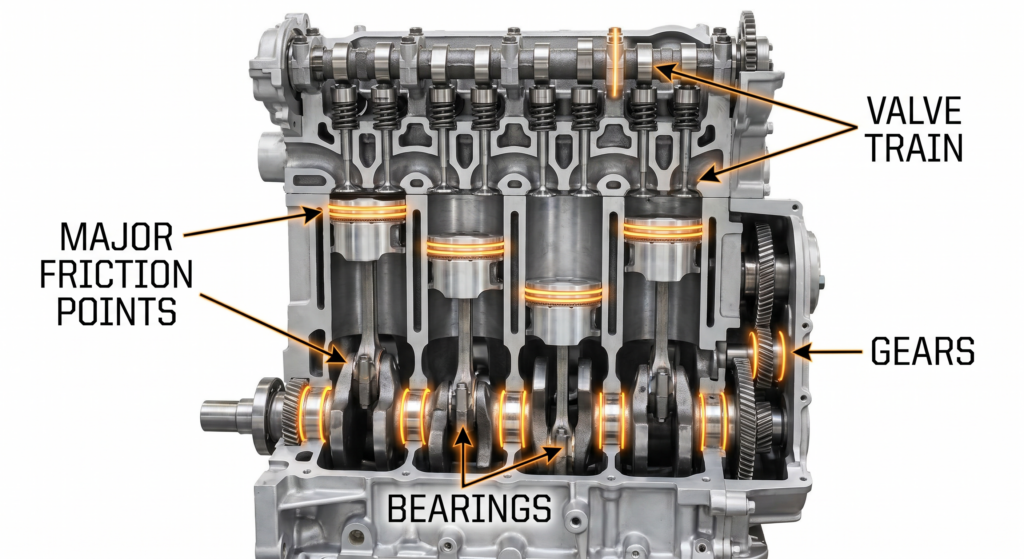
Friction’s twin is wear. Every time two surfaces slide or rub, microscopic material is lost, tolerances loosen, and parts eventually fail. A coating that reduces friction usually reduces wear at the same time, which is why this single technology attacks two problems at once.
How slick is slick
Here is where Nanize’s headline achievement becomes relevant to machinery. Friction is measured by a coefficient of friction, where lower means slicker, and Nanize claims a remarkable figure: its coatings reach a coefficient of friction as low as 0.008, which the company describes as among the lowest ever demonstrated. For perspective, that is well below PTFE, the benchmark most engineers reach for when they want “slippery.”
Nanize designs its formulations specifically to exploit this in mechanical settings. Nanize ultra-rapidly cured polysilazane coatings are inherently extremely low-friction and can be applied to a wide variety of substrates. Applied to components that slide, rub, or rotate, an ultra-low-friction surface means less energy lost to friction and less material lost to wear.
Why ceramic chemistry is right for engine conditions
A coating inside an engine has to do more than be slippery; it has to survive brutal heat and chemical exposure without breaking down. This is where the ceramic nature of polysilazane earns its place. The material is prized for high-temperature and oxidation stability, excellent scratch, abrasion, and impact resistance, high hardness above 9H, and strong chemical resistance, with most of these properties superior to conventional silicone-based coatings.
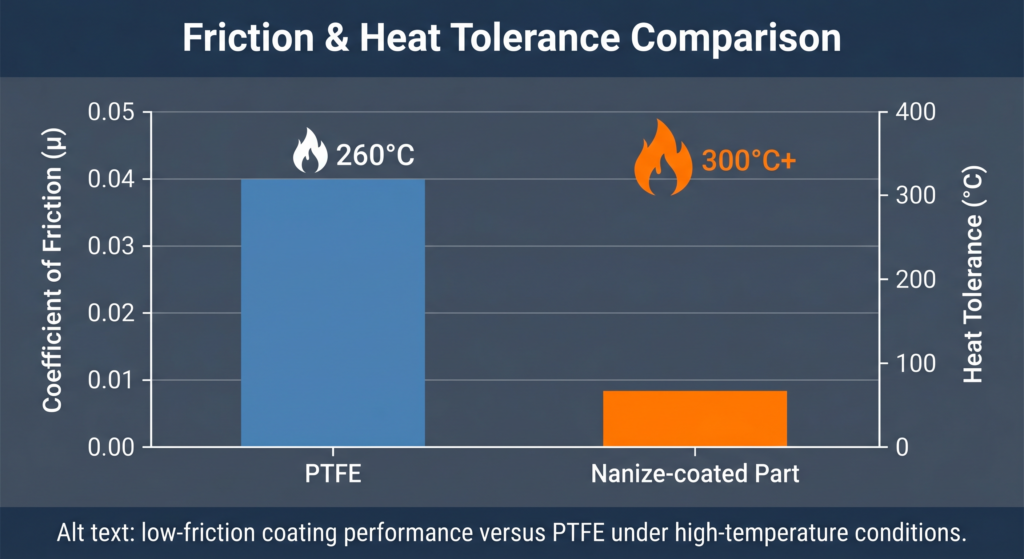
Nanize emphasizes that its chemistry can be tuned for exactly these extremes. By bonding nano-additives to the polymer backbone, the cured coating can be made to operate at temperatures up to and above 1000°C, alongside super-hydrophobicity, anti-microbial properties, and corrosion resistance. A coating that stays hard and slick at engine temperatures, resists the chemicals in fuel and oil, and bonds permanently to the metal is close to the ideal for a wear surface.
Where it goes inside the car
The candidate list is long: piston components, bearings, valve-train parts, gears, seals, and fasteners, anywhere two surfaces meet under load. Nanize also points to a benefit beyond the engine, in the machinery that builds and moves automotive parts. Through creating slippery, low-coefficient-of-friction durable coatings, equipment runs more efficiently with lower energy costs, reduced downtime to replace worn parts, and a reduction in damage to finished products caused by surfaces rubbing against each other.
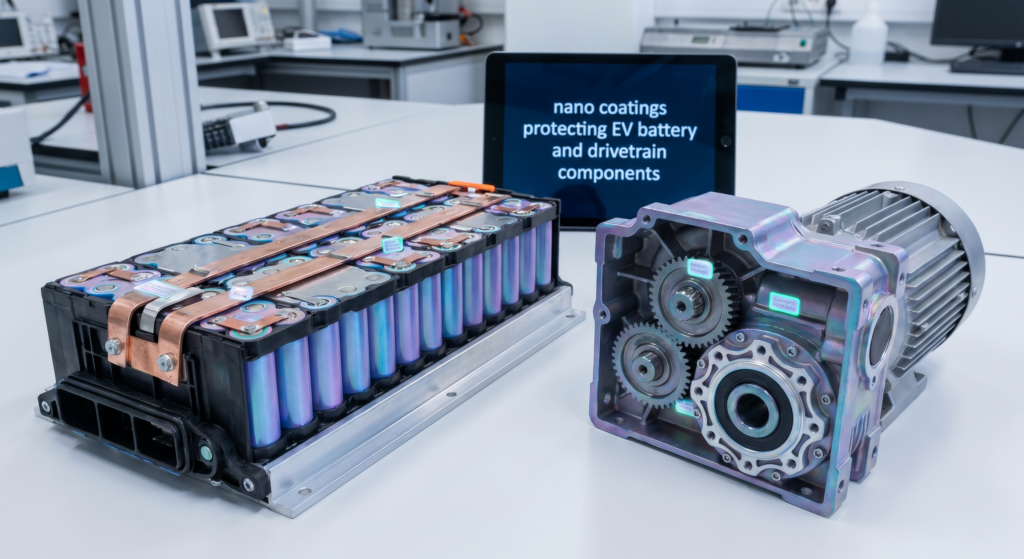
And because the coating cures cool and fast, it can be applied to components that high-temperature processes would damage. Nanize coatings can be applied using standard high-volume industrial processes and cured quickly at temperatures below which damage might occur, and their dielectric properties make them especially suitable for batteries and other electronic assemblies, an increasingly important point as cars electrify.
Why This Matters More in the Electric Era
It is tempting to think friction coatings are a fading concern as engines disappear, but the opposite is true. EVs still have bearings, gears, and drivetrains where friction steals range, and they introduce new surface challenges of their own. Battery packs need protection, thermal management, and electrical insulation, and Nanize’s dielectric, corrosion-resistant coatings are positioned squarely for that role. The shift to electric does not retire the surface-protection problem; it relocates and multiplies it.
The Practical Case for Carmakers
For a manufacturer weighing this, the appeal lines up on several fronts at once. The cure is fast and cheap to run: complete curing in 30 seconds at 70°C without a catalyst, evidenced by FTIR testing, which slots into existing high-volume lines rather than demanding new ovens. The durability is engineered to ship, not just to win a lab benchmark; Nanize positions its coatings as offering ceramic-like, space-grade performance previously associated with NASA’s mission-specific materials, but engineered for mass-market scalability. And it sidesteps the regulatory cliff hanging over fluorine chemistry entirely, since the whole platform is PFAS-free.
The Takeaway
Nano coatings change the automotive equation on two fronts at once. On the outside, a hard, water-shedding, covalently bonded layer keeps paint, glass, lamps, and sensors clean, clear, and scratch-resistant, which is now a safety feature as much as a cosmetic one. On the inside, an ultra-low-friction ceramic coating that survives heat and chemicals cuts the energy wasted to friction and the material lost to wear, extending the life of the parts that fail first.
The unifying idea is simple: stop treating surfaces as disposable. As Nanize frames its purpose, its coatings are transforming surface protection across multiple sectors, enabling cleaner, safer, more efficient performance wherever advanced coatings are needed. In a car, that means panels that stay sharp, sensors that stay clear, and engines that run smoother and last longer, the kind of improvement a driver never sees but feels in every mile.