
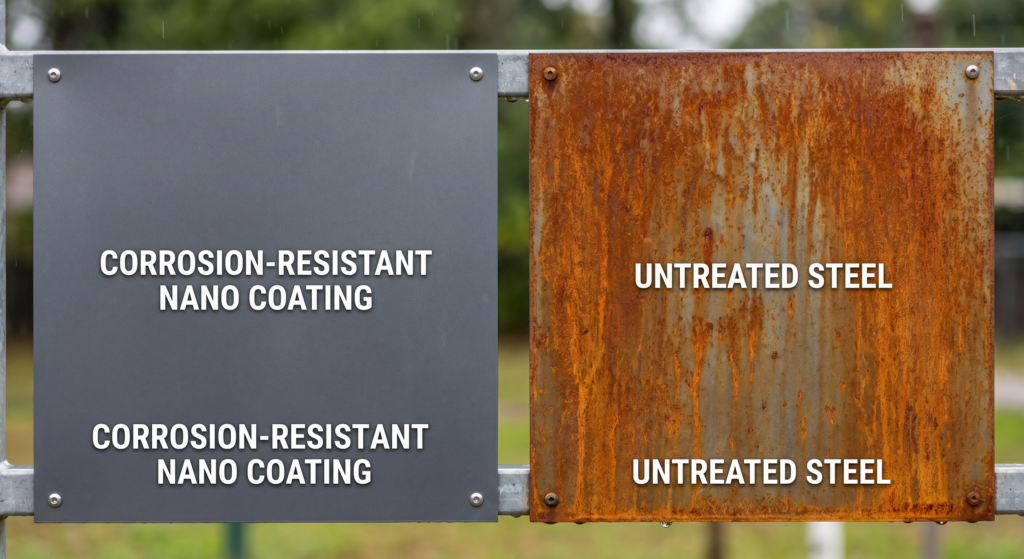
Corrosion is one of the most expensive problems in any industry that relies on metal. It eats away at structures, weakens components, and forces costly repairs and replacements. Paints and primers help, but they often sit loosely on the surface and break down over time. Nano coatings take a different route, and the chemistry behind them is worth understanding.
Why metal corrodes, and why ordinary coatings struggle
Most protective layers fail for the same basic reason: they rest on top of the metal rather than becoming part of it. Once that layer cracks, chips, or peels, moisture and air reach the surface underneath and corrosion sets in. A coating that bonds chemically to the metal, instead of just covering it, removes that weak point.
How polysilazane coatings resist corrosion
Nanize, a materials company based in Narvik, Norway, builds its coatings on polysilazane chemistry. The company lists corrosion resistance among the properties its coatings can be tuned to deliver. According to Nanize, the ability to covalently bond nano-additives to the polymer backbone can, upon curing, confer specific characteristics such as super-hydrophobicity, operation at temperatures up to and above 1000°C, anti-microbial, corrosion resistance.
The protection comes from how the coating sets. Nanize describes the cured result as hard, durable, glass-like and dense 3-dimensional Si-O-Si dominant cross-linked structures that are covalently bonded to the substrate. A dense, glass-like layer that is chemically locked to the metal gives moisture and contaminants very little chance to get through.

Why the bond is the key to lasting protection
A corrosion barrier is only as good as its grip on the surface. This is where Nanize puts its emphasis. The durability and long-life of Nanize coatings is achieved through excellent cross-linking during the curing process, combined with covalent bonding to the substrate to prevent flaking and delamination in use. If the layer does not flake or peel, the metal underneath stays sealed for far longer.
Water repellency adds a second line of defence
Corrosion needs moisture, so a surface that sheds water helps on its own. Nanize coatings have a high degree of hydrophobicity and an extremely low coefficient of friction that significantly reduces the build-up and adhesion of dirt on the surfaces to which they are applied. Less water and dirt sitting on the metal means fewer of the conditions corrosion depends on.
A PFAS-free, low-temperature process
Many traditional protective coatings rely on PFAS or need high-temperature curing. Nanize avoids both. Its coatings are PFAS-free, and the company states they fully cure in under 1 minute below 70°C to create market leading hard scratch-resistant long-life coatings. A cure that runs cool and fast means the protective layer can be applied efficiently and on a wider range of parts.